RICK REA: Helping You Grow Through Online Marketing
  • Home
  • Blog
    • Social Media News
    • SEO Marketing News
    • Digital Trends News
    • Photography News
    • Mobile Marketing
    • Business News
    • Gadget News
    • Printing News
  • Contact
  • About
  • Subscribe

Dwayne Johnson and John Krasinski did the Murph Challenge together

5/29/2018

0 Comments

 
https://ift.tt/2schgHl

Dwayne Johnson and John Krasinski did the Murph Challenge together

https://ift.tt/2soyujS


Two fit friends, John Krasinski and Dwayne "The Rock" Johnson, spent Memorial Day working out together for a good cause.

The pals took part in the Murph Challenge, a workout and annual fundraiser in honor of Lt. Michael P. Murphy, a Navy Seal who died during combat in 2005.

The challenge begins with a one-mile run, followed by 100 pull-ups, 200 push-ups, 300 squats, and a second one-mile run. On top of al that, participants are encouraged to wear a 20-pound vest to get the full effect of a Navy Seal workout.

Krasinski shared a video of himself ahead of the challenge where he took the time to thank all the men and women serving the U.S., and to introduce his friend "Dave," also known as The Rock.

"A dude named Dave who works out at my gym who wanted to do it with me," the actor joked, just before The Rock appeared from off frame to say, "Yeah, uh, first of all, it's my gym, and I'm Dwayne."

"I just want to say what an honor it was to drop sweat in honor of Lt. Mike Murphy," The Rock said in a second post-workout video shared to his Instagram page. "I want to thank brother John for considering me and asking me to do this and thank you brother Chris Pratt for originally having John do it last year."

Last year, Krasinski and Pratt teamed up for the challenge to honor past and present members of the armed forces. (This year, it appears Pratt was busy filming a Lego motorcycle film.)

This year The Rock and Krasinski seemed to recover nicely from the challenge, but last year Pratt and Krasinski were noticeably out of breath, shaking, and sweating. Understandable, guys.

This year The Rock promised he'd invite another special guest to participate in the challenge next Memorial Day, but until then he and Krasinski will be proudly celebrating their workout.

Nice job, guys!

Want more clever culture writing beamed directly to your inbox? Sign up here for the twice-weekly Click Click Click newsletter. It's fun – we promise.

Social Media

via Social Media https://ift.tt/2DCFv97

May 29, 2018 at 09:27AM
0 Comments

How to Pin a Facebook Lead Ad to Your Facebook Page

5/29/2018

0 Comments

 
https://ift.tt/2xmm6Xt

How to Pin a Facebook Lead Ad to Your Facebook Page

https://ift.tt/2LEpiB0

social media how toWant to generate qualified leads from Facebook?

Wondering how to make your email lead form what people see when they visit your Facebook page?

In this article, you’ll discover how to use Facebook lead ads without spending any money.

How to Pin a Facebook Lead Ad to Your Facebook Page by Meg Brunson on Social Media Examiner.

How to Pin a Facebook Lead Ad to Your Facebook Page by Meg Brunson on Social Media Examiner.

#1: Create a Lead Ad Via Ads Manager

While Facebook doesn’t give you the option to build an organic lead post, you can create a lead ad in Ads Manager (as well asd schedule and turn it off so you don’t spend any money) and organically post the ad to your page via the Page Posts dashboard. Be sure to pin the post to the top of your timeline to give it more visibility.

To get started, you need to create a new campaign in Ads Manager. Click the triangle icon in the upper-right corner of your Facebook home page and select Create Ads.

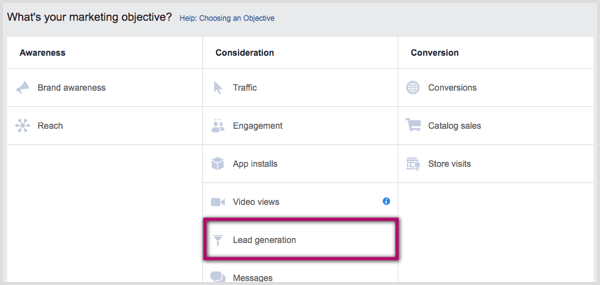
At the Campaign level, choose Lead Generation as your campaign objective.

Facebook campaign objectives in Ads Manager

Then name the campaign and click Continue to navigate to the Ad Set level.

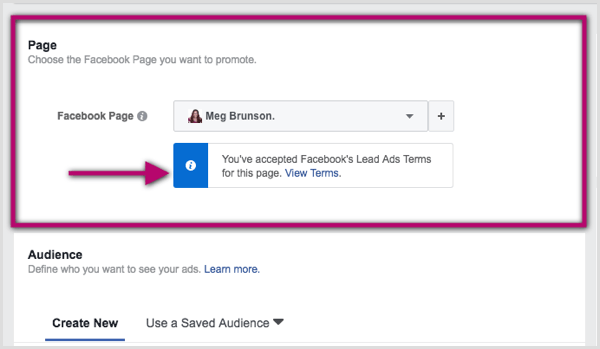
Select the page to which you want to post the lead form. If you haven’t already accepted Facebook’s Lead Ads Terms, you’ll be prompted to accept them. Note that you have to accept the terms individually for every page you want to use lead forms with.

Select Facebook page for lead ad in Ads Manager

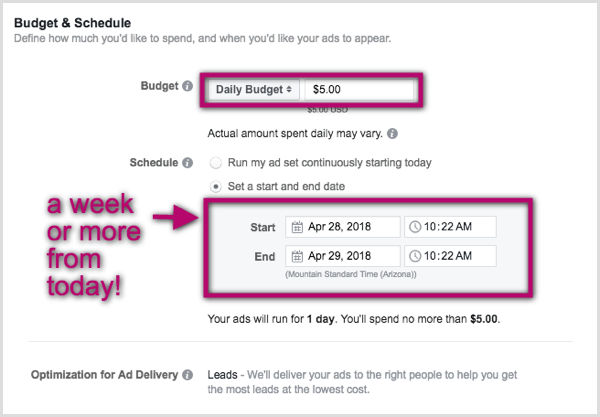
Now edit the budget and schedule. You don’t have to spend any money on this ad to post the content organically to your page. I recommend that you set the budget to a small amount and schedule the ad to run for 24 hours a week from today. This gives you plenty of time to turn the ad off before it spends your budget, but also ensures that if you forget, the financial impact will be minimal.

Set budget and schedule for Facebook lead ad.

Targeting and placements aren’t important in this case because you’ll be posting the content organically, as opposed to running it as an ad. To save time, leave the targeting and placements at the default settings and click Continue to navigate to the Ad level.

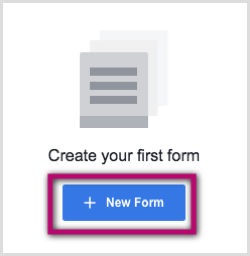
Now select your creative and write the copy you want to use for your pinned post. Then scroll down and click the blue + New Form button to create a new form.

New Form button for Facebook lead ad

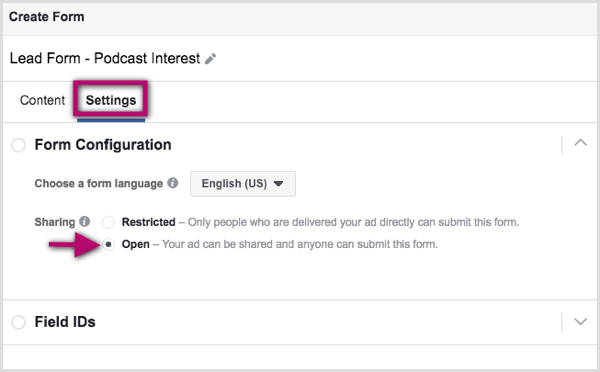
To post a lead form organically, you need to allow it to be shared and accessed by anyone. By default, the lead form Sharing setting defaults to Restricted. To change this, click the Settings tab and change the sharing capabilities to Open.

Settings tab of Create Form dialog box

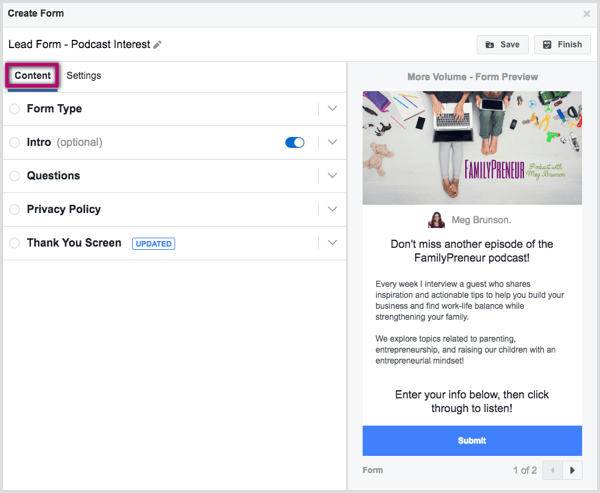
Next, click the Content tab and build your lead form. Here you enter the copy you want your audience to see when they open the form. You can add an intro, ask questions, and set up the thank-you screen. Note that Facebook requires anyone running a lead form to have a privacy policy on their website and link to the privacy policy in the lead form.

Content tab of Create Form dialog box

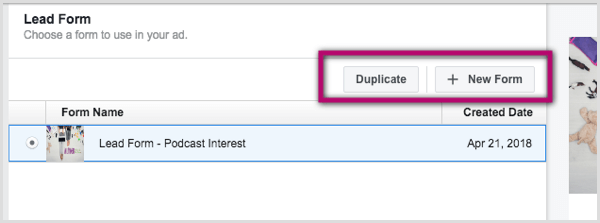
If you’re sure your lead form is set up correctly, click Finish. Keep in mind that Facebook doesn’t allow you to edit lead forms, so once you click Finish, you can’t make changes. If you discover you made a mistake or forgot to add something, you can duplicate the form to make changes and save an alternate form, or start over with a new form from a blank template.

Duplicate and New Form buttons for Facebook lead ad

Finally, click the green Confirm button to submit the ad for review.

#2: Connect the Lead Ad to Your CRM

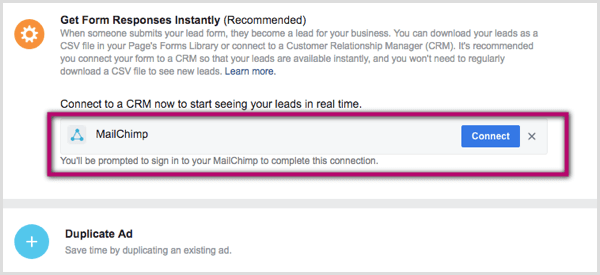
After you submit the ad, Facebook prompts you to connect a CRM system, which will allow you to get your leads in real time. Search for your CRM (or email) provider in the list of integrations. If you don’t have an email provider, MailChimp has a free membership option.

Connect CRM to Facebook lead ad.

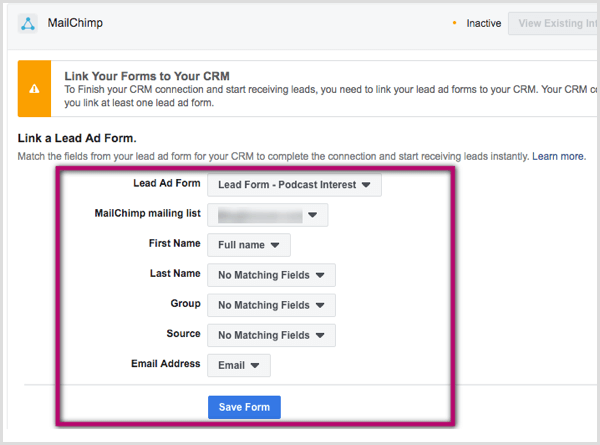
After you sign into your CRM from within Facebook, link your lead form to the correct list within your CRM and match the lead form fields to the data points of your CRM system. The options you see vary based on the provider and the fields you’ve used in your lead form.

Link lead ad form to CRM.

When you’re done, click Save Form. Any leads you generate will now be sent to your email provider in real time as they come in.

If your CRM or email provider isn’t offered internally by Facebook, you might check out Zapier. It’s a third-party service that integrates with many platforms including Facebook lead ads and a variety of CRM tools. You set up rules, such as “when a lead comes through this Facebook lead form, add the lead information to this CRM list.” Services start at $20/month to use the premium lead ad Zaps.

Connecting the lead form to your CRM helps automate the lead generation process, so be sure to complete this process before you post the lead form publicly.

#3: Post the Lead Ad to Your Page

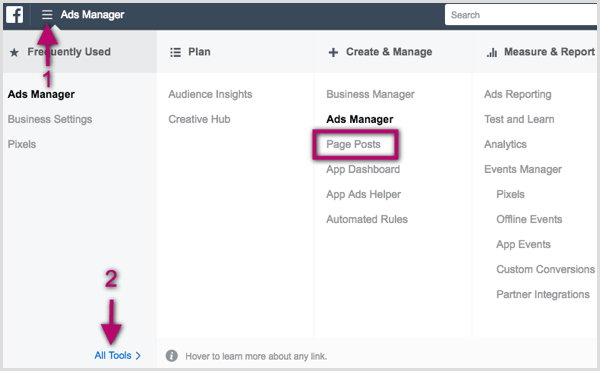
Now that your ad is in review and the lead form is integrated with your preferred CRM system, it’s time to publish the ad as an organic post to your Facebook page. In Ads Manager, click the three line icon, hover over All Tools, and click Page Posts in the Create & Manage column.

Page Posts option in Facebook Ads Manager

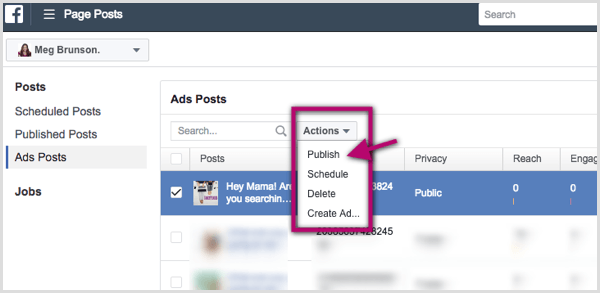
In the left menu on the Page Posts page, choose Ads Posts. Then select the checkbox next to the ad you just created. (The ad should be at the top of the list.) From the Actions drop-down menu, either publish the post automatically or schedule it for a later time.

Actions menu options on Page Posts page

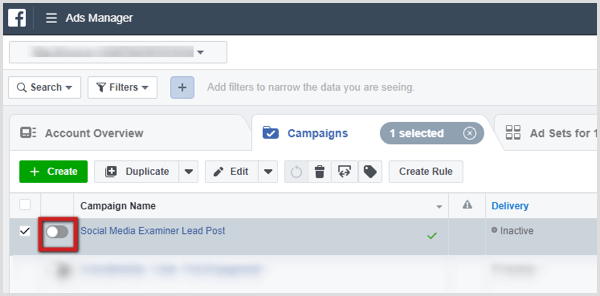
Once you’ve published or scheduled your post organically, go back into Ads Manager and turn off your ad. This step is essential to ensure you aren’t charged any money.

Toggle to turn on campaign in Ads Manager.

#4: Pin the Lead Form Post to the Top of Your Page

Now that you’ve published your lead form, you want to pin the post to the page to give it more visibility.

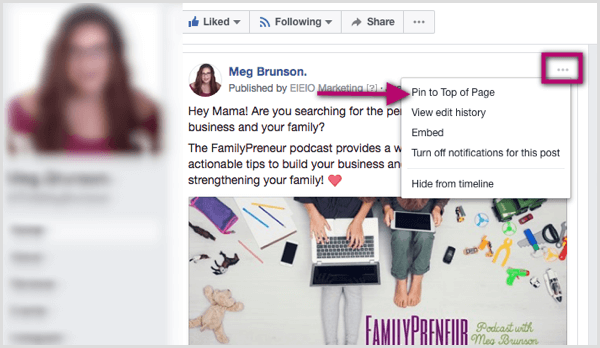
To do this, open the post, click the three dots icon in the upper-right corner, and select Pin to Top of Page. The post will remain the first post users see when they visit your page.

Pin to Top of Page option for Facebook post

#5: Drive Traffic to Your Facebook Page

Now that you have your lead form and a strong CTA pinned to the top of your page, you want to drive qualified traffic to your page so people will see your post. Here are four tips to increase organic traffic.

Link Your Page to Your Personal Profile

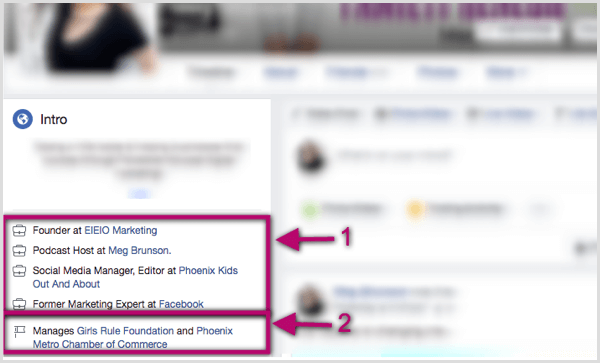
When friends and interested users visit your personal profile, make sure they know what you do and where they can learn more about your business. Here are two effective ways to link directly to your page via your profile:

  • If you list your page as a “workplace,” it will show up in the first section of your profile, along with the title you hold at that business.
  • If you link yourself as a “team member” on the page, the page will appear in the second section.

Links in Intro section of Facebook profile

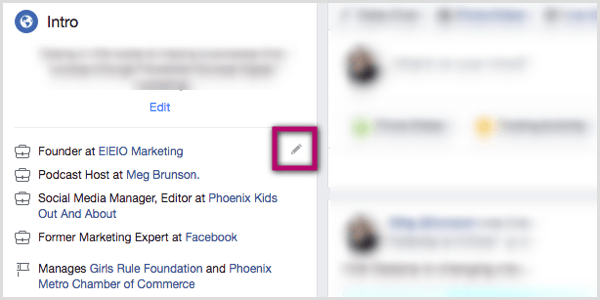
To add a workplace (section 1), hover over that area on your profile and click the pencil icon that appears. Now you can add a workplace and select your page.

pencil icon in Intro section of Facebook profile

To signify that you’re a team member on a page (section 2), go to the About tab of the page you manage. Then click Add Yourself as a Team Member. Currently, this feature is available only for business pages that don’t use Business Manager. If you use Business Manager, add your page as a workplace instead.

Facebook Add Yourself as Team Member link for Facebook page

Participate in Groups

Once you connect your personal profile to your page, begin building relationships with your target audience in Facebook groups. Don’t use salesy messaging, though. Instead, focus on providing value to the group. As people get to know you, they’ll visit your personal profile to learn more about you, where it should be immediately obvious where they can get more information about your business.

People like doing business with people they know, like, and trust, and relationship marketing is a great way to promote your business in a soft way.

Post a Variety of Content to Your Page

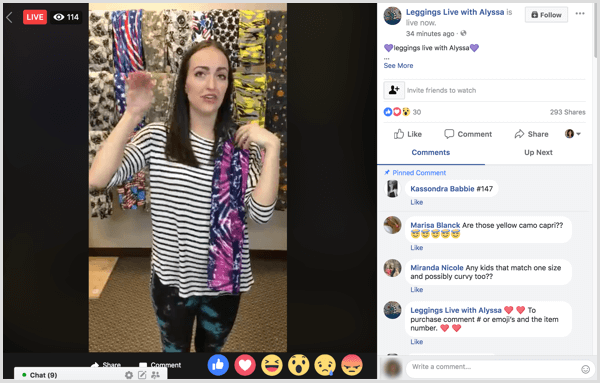
Frequently posting exclusive content on your page gives your audience a reason to visit your page often. It’s recommended to post a variety of content types, including live video, exclusive offers, and contests. Live video is a good choice because Facebook’s algorithm favors it, and it gets more views and engagement than all other post types. When you go live, be sure to promote your pinned opt-in!

Facebook Live video example

Contests or promotions can be beneficial because if people know you post them often, they’ll learn to browse the timeline when they’re interested in your products or services. Make sure you consistently post fresh content to keep users coming back to your page.

Promote Your Page via Other Marketing Channels

Promoting your Facebook page through your other marketing channels lets your audience know you have fresh content worth checking out on your timeline. Here are some ways to do that:

  • Place links and/or hyperlinked Facebook logos in the header, footer, and/or sidebar of your website.
  • Link to your Facebook page on other social media platforms that allow it.
  • Post periodically on other platforms to promote exclusive content available on your Facebook page.
  • Regularly promote your page through your email list.

Take advantage of every platform you have to bring awareness to the value you provide on your Facebook page. By driving traffic to your page, you can organically grow your email list through the pinned lead form.

Conclusion

Facebook lead forms are a lead generation tool optimized for mobile use. Because the vast majority of social media activity occurs on mobile, lead ads are the go-to ad type for marketers looking to grow their mailing lists and generate leads. With the Page Posts dashboard, you can publish a lead ad as a post on your page to grow your mailing list organically.

What do you think? Have you used lead ads to grow your email list? Will you consider publishing lead forms to your page? Please share your thoughts in the comments below.

Discover how to use Facebook lead ads without spending any money.


Social Media

via https://ift.tt/1LtH18p

May 29, 2018 at 05:09AM
0 Comments

How to Increase Conversions by Avoiding These 7 Navigation Mistakes

5/28/2018

0 Comments

 
https://ift.tt/2IVO8u4

How to Increase Conversions by Avoiding These 7 Navigation Mistakes

https://ift.tt/2J8k8yy

I see this problem all the time when I’m consulting businesses. They are getting tons of traffic to their websites, but visitors just aren’t converting.

If this sounds like your situation, don’t hit the panic button yet.

Look on the bright side. At least you’re having success when it comes to driving people to your website. But if you want to design a homepage that converts, you have to look at how visitors navigate through your pages.

Every day I see websites with design flaws.

Brands spend much time trying to improve their SEO rankings and don’t spend enough effort improving their websites. Creating a website that converts isn’t an overnight process.

This takes time, effort, and patience. You need to learn how to run A/B tests and analyze your design elements so that you can make calculated improvements.

That said, there are certain changes you can implement sooner rather than later.

I’ve taken the time to identify the top 7 navigation mistakes I see on a regular basis. Use this list to analyze your existing website to make sure you’re not making the same blunders.

1. Labels and headlines that don’t drive conversions  

When someone visits your website, it’s all about making a first impression. Think about what people see on your menu bar and headline tags.

I don’t like to throw businesses under the bus. So I’m not going to show you a specific example of a website that’s doing this wrong. But I’m referring to headlines and labels with terms like:

  • who we are
  • what we do
  • about our hiring process
  • places we work

While this information should be included on your website, it shouldn’t be the focal point of your design. None of these will lead to conversions.

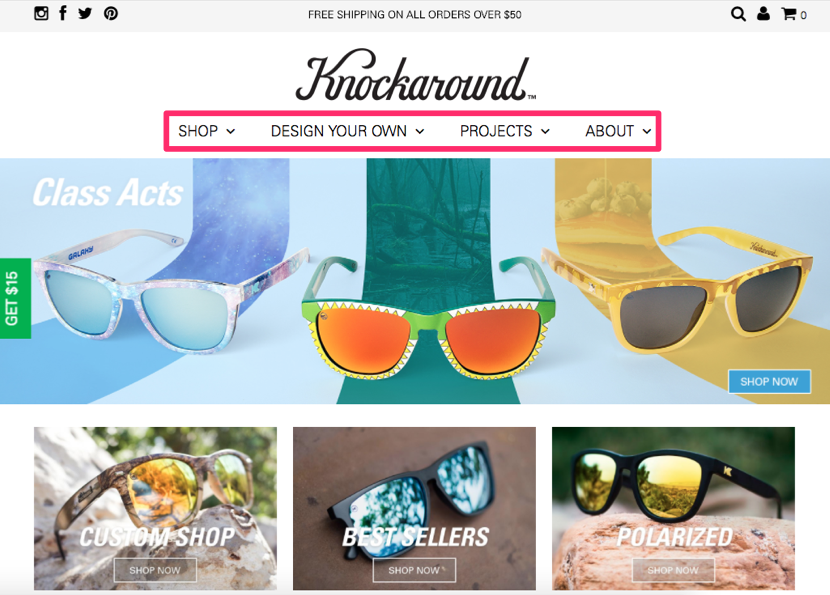
Let’s take a look at a brand that understands this concept and has appropriate labels and headlines on its site. Check out the homepage for Knockaround:

image7 8

The navigation menu has only four options, which is perfect.

We read from left to right, so the first two choices we see are “shop” and “design your own.” Both of those labels were written to help drive conversions.

Information about the brand’s history, staff, and operation are reserved for the “about” headline.

I don’t want you to think your brand story isn’t important. In fact, I’ve written an extensive guide on how to create an about us page that generates leads.

But when it comes to driving conversions, you need to shift your focus. Nearly all the clickable links in the example above from Knockaround will drive conversions.

The website has a clean and simple design, so it’s easy for visitors to be drawn to these conversion buttons. The result is increased sales.

2. Using a non-standardized layout

People have been browsing the Internet for years. Over time, there are certain standards we have grown to expect when we land on a web page.

It’s important for you to come up with a differentiation strategy for your marketing campaigns to help you stand apart from your competition. But when it comes to your website navigation, stick with a standard layout.

For example, where do you expect to see a navigation menu when you visit a new website?

You’ll assume it’s at the top of the screen. Burying your menu in the middle of the screen will look strange for your visitors.

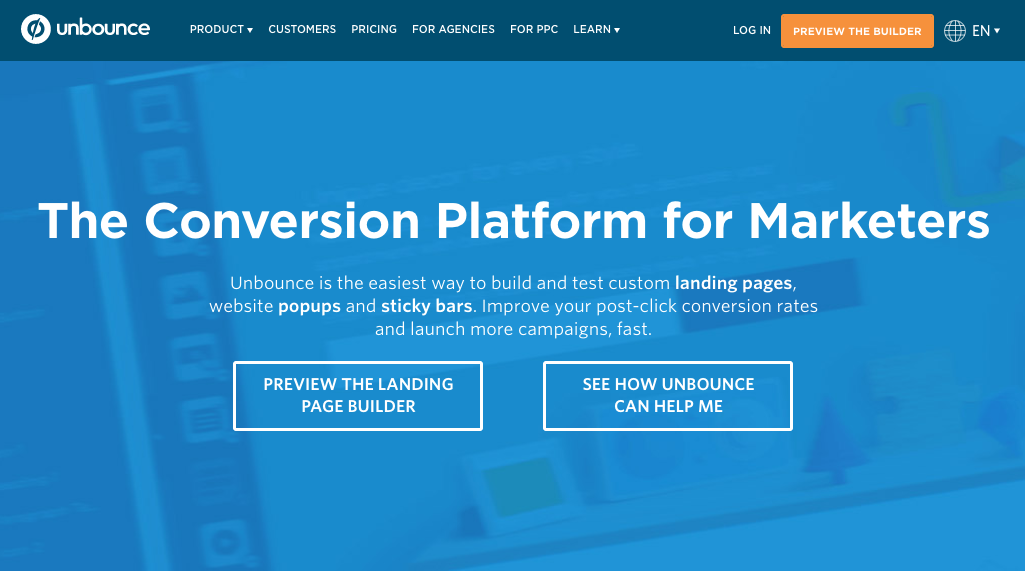
They may not spot it right away, and it’s not something they are expecting to see. Here’s an example of a standardized website layout from Unbounce:

image8 7

As you can see, it follows the format of most websites you see on a daily basis. The standard typically follows this progression:

  • menu bar at top of screen
  • large headline
  • short description sub header
  • CTA button

You might be thinking this is too boring. Think again. Using a standardized page layout will help you drive conversions. Visitors will know exactly where to navigate without having to think too hard.

Let me give you an analogy to further illustrate the point. When you are looking at a picture on your smartphone or tablet, how do you expect to zoom in on the image?

You use two fingers on the screen and spread them apart. That’s what you’ve grown accustomed to.

But what if that command didn’t work for certain websites? You’d be thrown off and probably wouldn’t convert. Plus, you’ve been using smartphones for far less time than you’ve been browsing the Internet.

So stick with what people are familiar with, and don’t stray too far from a standard layout.

3. Conflicting CTAs

Having call-to-action buttons on your website is necessary to drive conversions. But too many CTAs not related to each other will confuse the visitor.

Most people think that adding multiple CTA options to each page of their websites will increase the chances of one getting clicked. But it actually has the opposite effect.

These are the typical CTAs:

  • buy now
  • sign up today
  • join our email list
  • refer a friend
  • click here to receive your discount

What’s wrong with these CTAs? Nothing. Unless they are all on the same screen at the same time.

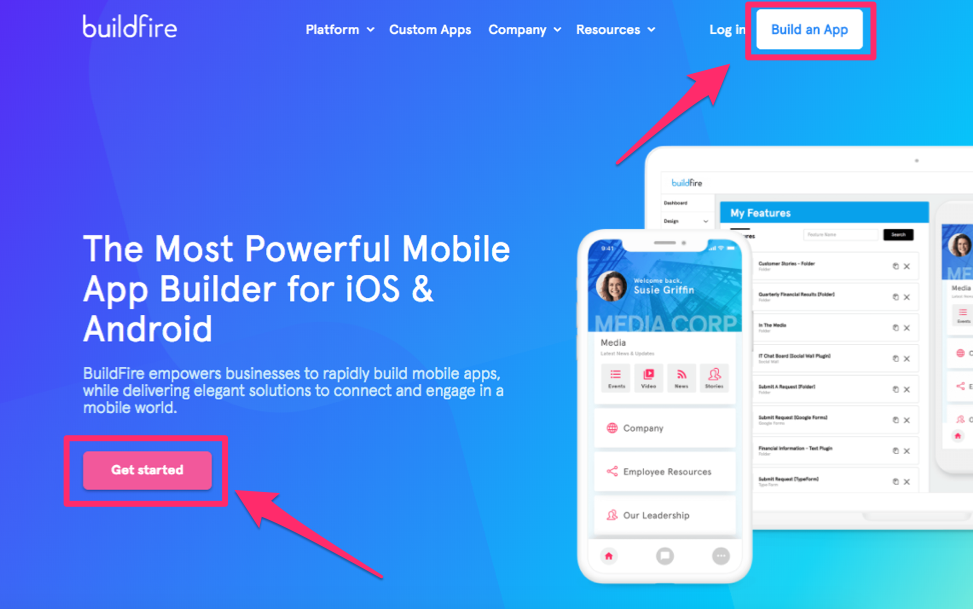
Take a look at the BuildFire homepage:

image10 2

BuildFire specializes in custom mobile app development. When you land on its website, you’ll see two call-to-action buttons.

Although the wording of each button is different, they both drive the same type of conversion.

The “get started” button is intended for people to start building their mobile apps. If they click the “build an app” button, they’ll be accomplishing the same thing.

In fact, both CTAs bring the website visitor to the same landing page. So it’s all about which button speaks to the user. Those are the only two options they need to choose from.

If this website had additional buttons, e.g., to try to get email subscribers, sign up for a free trial, or receive a coupon code, it would hurt its conversions.

It’s all about your priorities. For some of you, getting more email subscribers may be the priority of your current marketing strategy. If that’s the case, eliminate any other CTAs on your page that conflict with your conversion goals.

4. Too much clutter

Your web design needs space to breathe.

Don’t try to fill every inch on the screen with text and images. Empty space can be just as effective.

Empty space in your web design will ultimately help direct the visitor’s attention to your focal points. Now they won’t have a problem spotting your value proposition.

Websites with simple designs have higher conversion rates.

Having too many elements on your website will slow down the page loading time.

Pages that take more than four seconds to load can expect to see bounce rates increase by 100%. Websites that take eight seconds to load will have an additional 150% increase in bounce rates.

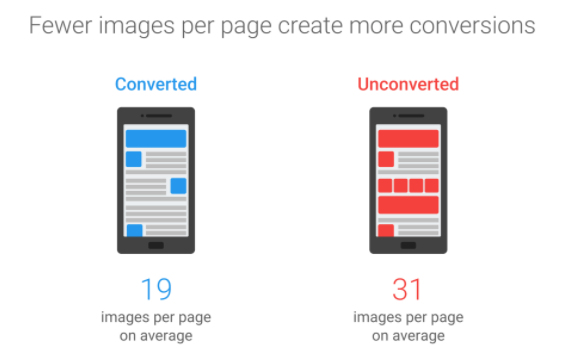
Consider removing images from your pages. Research from Google Analytics suggests that websites with fewer images have higher conversion rates.

image1 8

Based on everything we just discussed, this makes sense.

Lots of images will slow down your page loading time, increase bounce rates, and ultimately kill your conversions.

But if you remove clutter, simplifying your design, users won’t have an issue navigating through your pages.

5. Not accounting for scrolling

Most pages will require the visitor to scroll.

That’s fine. I’m not saying you shouldn’t have scrollable pages, but it’s important you recognize how your screen will change as the visitor navigates by scrolling.

Think about the current placement of your CTA buttons.

When someone scrolls down a page of your website, are the CTA buttons still visible? If the answer is no, it’s going to hurt your conversions.

Scrolling through a page is great because it gives the visitor more information about your brand, products, or services. But let’s say they get halfway down the screen and decide they want to convert.

If the conversion link is all the way back up at the top of the screen, they’ll need to scroll back and go hunting for it. That’s not a good scenario for you.

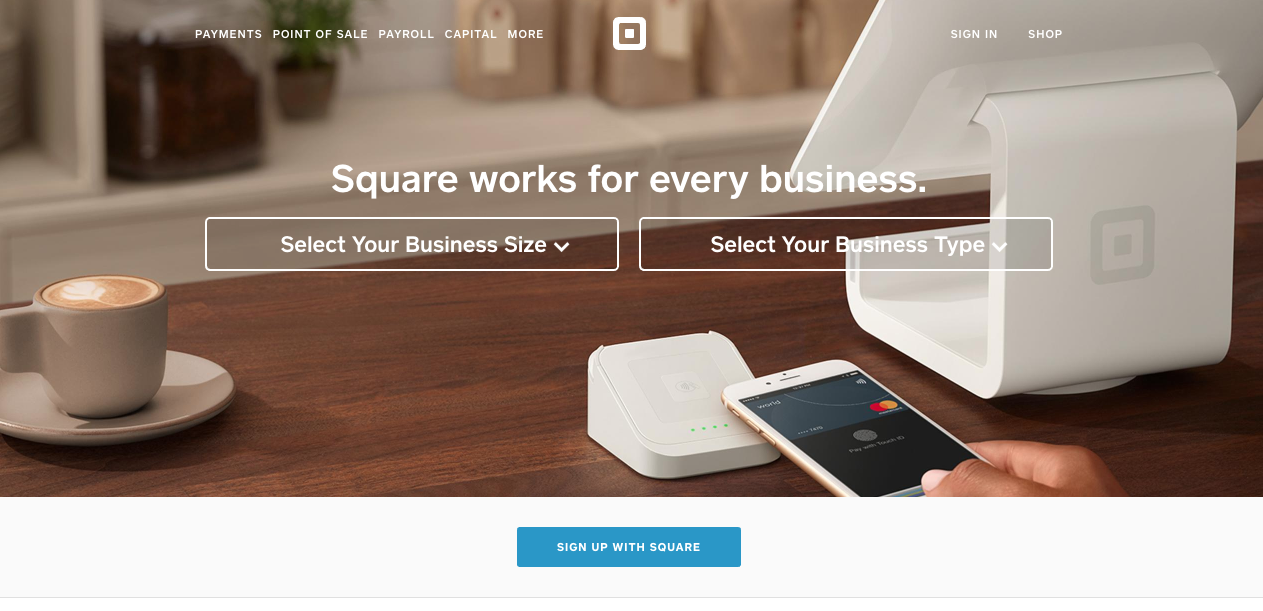
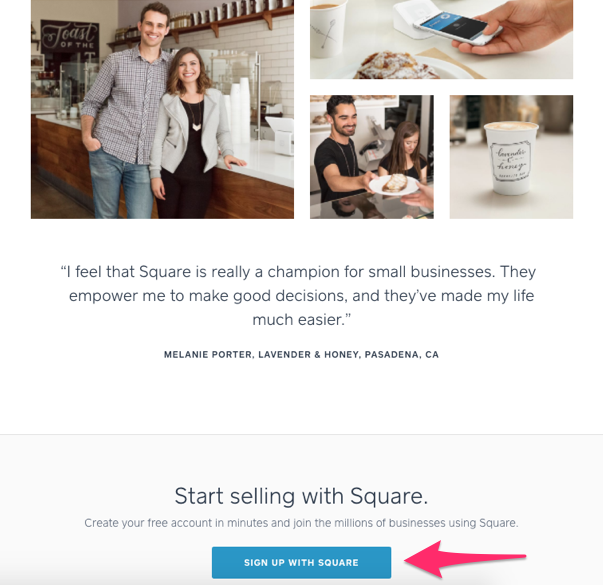
Each additional step people take to convert is going to hurt you. Let’s take a look at the Square website to give you a great example of what I’m talking about:

image9 3

This is its homepage. As you can see, it follows a standard layout and doesn’t have any clutter, which are two of our previous discussion points.

But what happens when you scroll lower on this page?

Let’s see if you can still locate the CTA button at all times:

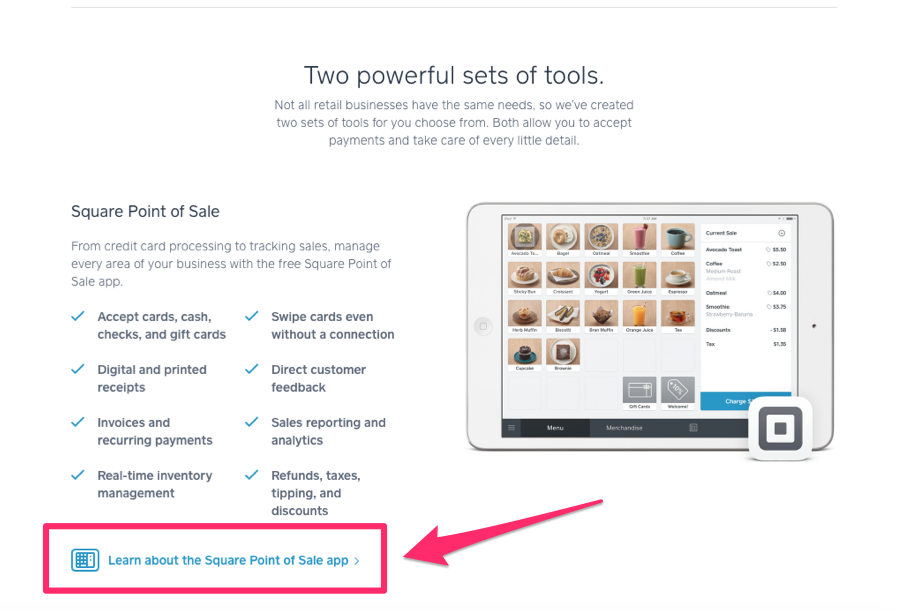
image4 8

This screenshot is from the same page.

The way the CTA fits on the screen makes it appear as if the visitor is on a new page. As you can see, the CTA button is still clear and visible.

Now, as the visitor learns more information about the product, they can click on the link and convert.

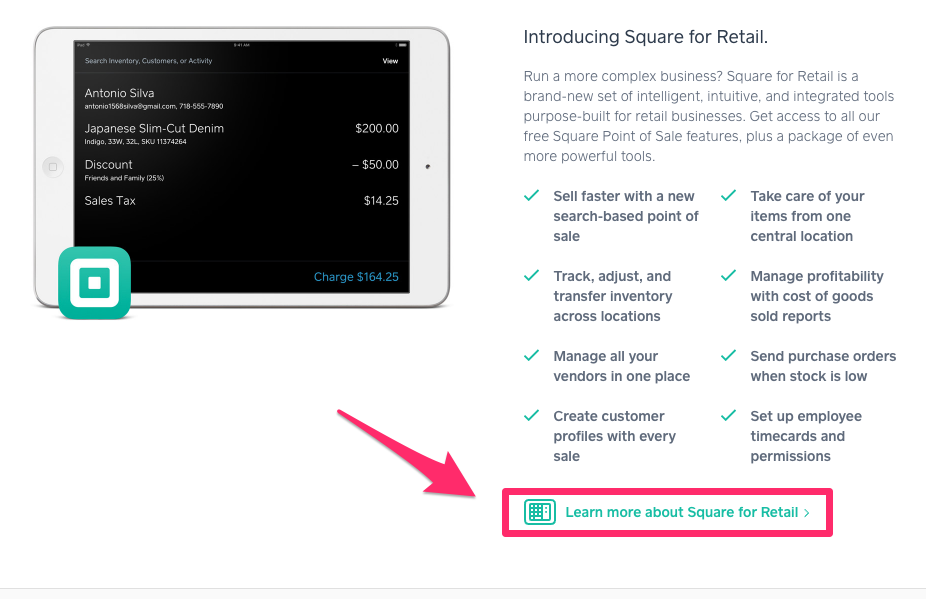
But that’s not the end of the page. Let’s continue scrolling to see whether this pattern continues:

image6 8The pattern is indeed the same.
Keep in mind we’re still looking at Square’s homepage. I haven’t navigated to another screen yet or made any clicks. But as I continue to scroll, I always have an option to convert.

This statement holds true all the way to the very bottom of the homepage.

image3 8

I think I’ve made my point clear.

Square has perfectly designed its navigation to ensure that website visitors always have an option to convert.

Use this as a reference for your pages as well. Keep in mind that each scrolling screen should almost appear as a completely new page to be as effective as possible.

You could also consider implementing a fixed menu bar with a CTA button at the top of your screen. That way, when a visitor scrolls, the menu is visible at all times.

6. Complicated checkout process

If you sell products or services on your website, you need to put shopping cart optimization at the top of your priority list.

Consider all the design elements on your checkout page.

If the buttons required to complete the transaction are hidden or mis-written, it’ll kill your conversions.

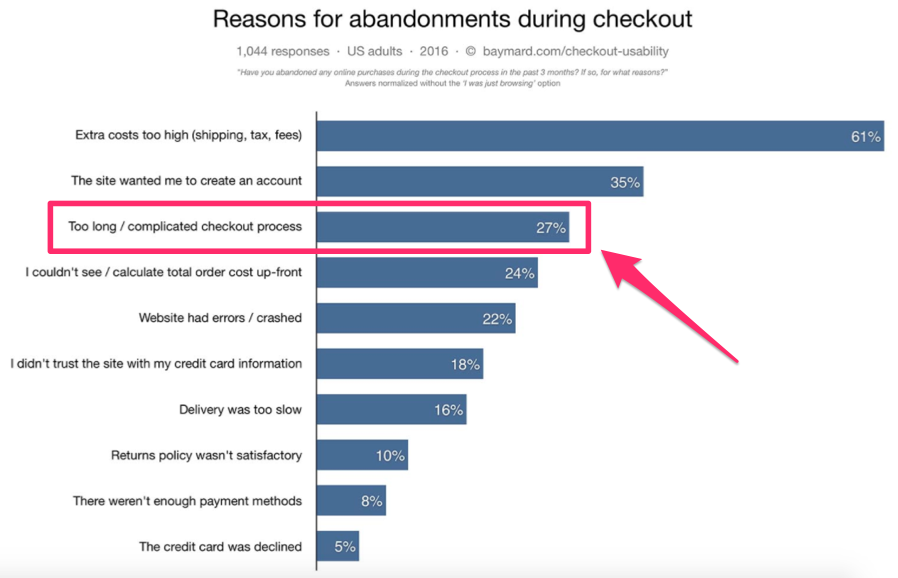
Furthermore, you need the checkout process to happen in as few steps as possible. Take a look at the top reasons for shopping cart abandonment:

image5 8

A checkout process that is long and complicated ranked third on this list.

Your navigation elements play a huge role in how customers finalize their transactions. So analyze your site, and figure out where customers are abandoning the page.

Make sure your purchase buttons are big, bold, and clearly displayed on the screen.

7. Forgetting about mobile users

Navigation on smartphones and tablets differs from navigation on computer screens.

Just because you implemented changes on your desktop site doesn’t mean your navigation is perfect. You still need to optimize your design for mobile users.

Remember earlier when I discussed the importance of speed? Well, speed is even more important when it comes to mobile browsing.

Mobile sites that take longer than three seconds to load have a 53% abandonment rate. Furthermore, 50% of mobile users expect pages to load in less than two seconds.

If you have an ecommerce site, this is extremely important for you to recognize. That’s because 70% of all mobile transactions are completed from smartphones.

When you optimize your mobile site, you need to make sure it encompasses all the previous design elements we discussed:

  • labels that drive conversions
  • standardized layout
  • similar CTAs
  • no clutter
  • scrolling-friendly

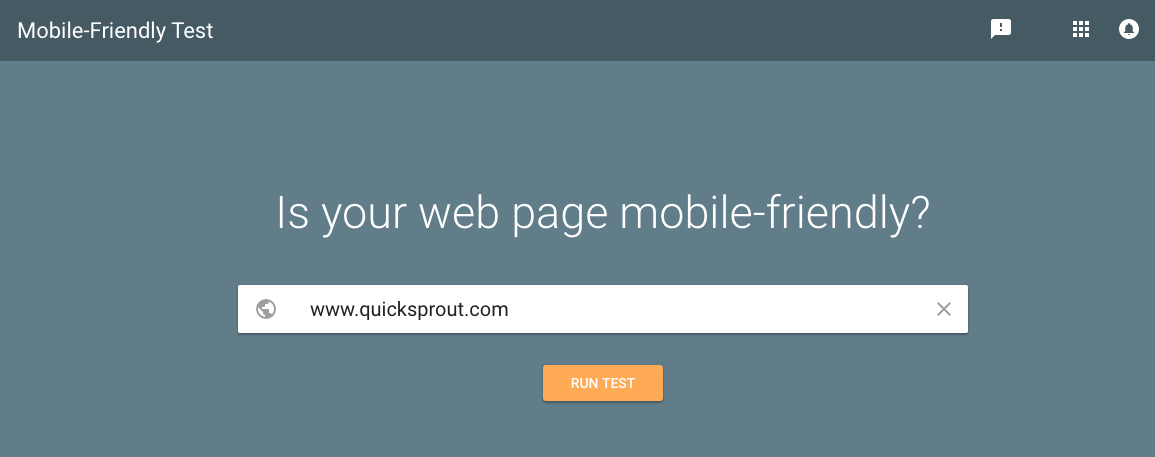
To check whether your mobile site is properly optimized, you can use tools such as the mobile-friendly test from Google:

image2 8

But just because the site is mobile optimized doesn’t mean all your navigation elements are perfect.

It’s up to you to manually make all those design changes if you want to increase your conversions.

Conclusion

Having lots of website traffic is great.

But traffic doesn’t automatically translate to conversions. If you think your page conversions are below satisfactory or have room for improvement, you need to take the time to analyze your navigation elements.

Recognize how visitors browse on your site. What do they see?

Their eyes will be drawn to your labels and headline options. Write them so they drive conversions.

Your website design isn’t the place to experiment with your differentiation strategy. Use a standardized layout for a smooth navigation. That’s what people are used to, so don’t confuse them.

The CTAs on your screen need to be related to each other. Too many conflicting CTAs will lower your conversion rates.

Remove clutter on the screen. Use blank space to your advantage.

Check what the users see when they scroll through your pages. There should always be a CTA button visible to drive conversions.

Simplify your checkout process. Don’t ignore mobile users.

If you avoid making these 7 navigation mistakes, you’ll see a significant improvement in your website conversion rates.

What navigation elements on your website need to change to increase conversions?


Social Media

via Quick Sprout https://ift.tt/UU7LJr

May 28, 2018 at 10:01AM
0 Comments

How to Retarget on Facebook and Instagram With Dynamic Product Ads

5/28/2018

0 Comments

 
https://ift.tt/2kwpNAM

How to Retarget on Facebook and Instagram With Dynamic Product Ads

https://ift.tt/2xmrycS

social media how toWant to retarget website visitors with ads for products they viewed but didn’t purchase?

Wondering how to set up dynamic product ads for Facebook and Instagram?

In this article, you’ll discover how to remarket to website visitors with dynamic product ads using Facebook Ads Manager.

How to Retarget on Facebook and Instagram With Dynamic Product Ads by Jordan Bucknell on Social Media Examiner.

How to Retarget on Facebook and Instagram With Dynamic Product Ads by Jordan Bucknell on Social Media Examiner.

What Are Dynamic Product Ads?

Dynamic product ads let you target customers who have visited your website and browsed a range of your products but left before completing the purchase. This is a very hot audience so it’s important to target them to encourage them to convert.

With dynamic product ads, you can create a tailor-made ad for each person with the products they’ve viewed on your website and a range of other products. They’ll see these ads on their Facebook and Instagram feeds the next time they log in.

The benefit of dynamic product ads is that you minimize the number of conversions lost at the last stage of the sales process. The ads remind customers of your products and increase the likelihood of a website visitor returning to your website to buy something. You can also spotlight offers, show product reviews, and tell users about delivery time or other key points.

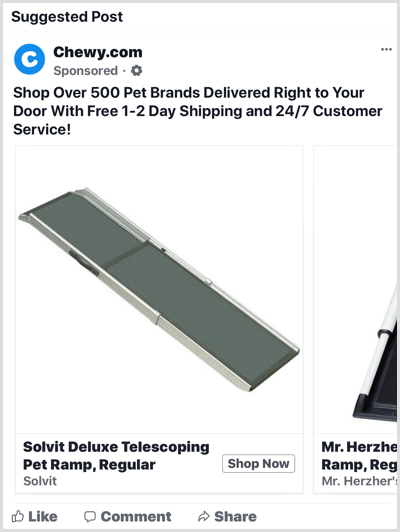
Facebook dynamic product ad example

Remember, these ads will likely be the most profitable Facebook ads you run, so it’s important you set them up correctly. By following these steps, you can get your own dynamic product ads up and running in no time.

#1: Set Up Facebook Pixel Events

The Facebook pixel helps ensure your dynamic product ads campaign serves up the right ads to the right audience at the right time. It’s a snippet of code that sits on your website and tracks the events (different actions) people take on your website. It’s important to set up the pixel and ensure it’s tracking correctly. If not, you won’t be able to get your dynamic ads to work properly.

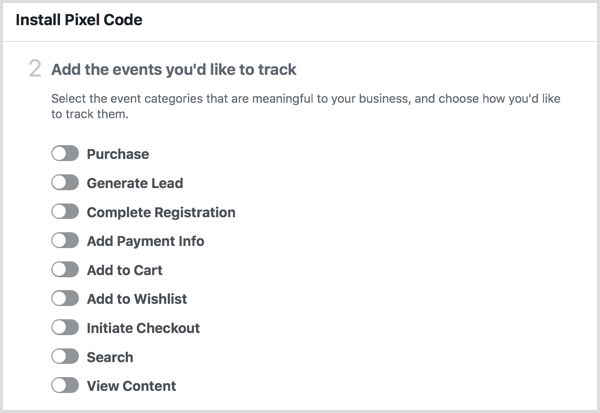
Three Facebook pixel events are important for dynamic ads: Purchase, Add to Cart, and View Content.

list of Facebook pixel events categories

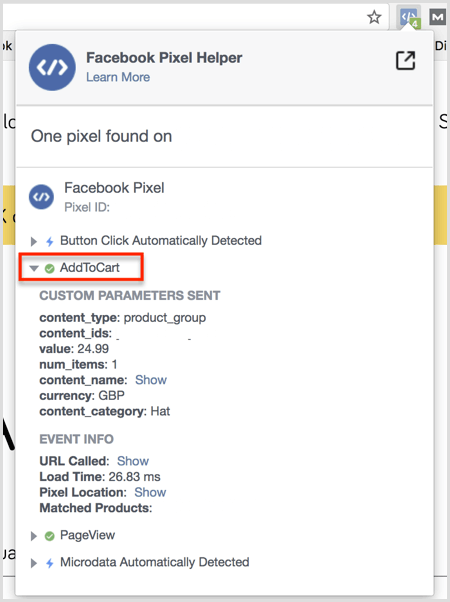
After you install pixel event codes on your site, you can check that the events are firing correctly by using a free Chrome browser plugin called Facebook Pixel Helper. After you install the plugin, a little pixel logo icon appears in your browser toolbar. All you need to do is visit the web page you want to check, click the Facebook Pixel Helper icon, and you can see what events are firing on that page.

Tip: Remember to disable your ad blocker when using this plugin. Otherwise, it may appear as though your pixels aren’t working.

Below is an example of what you might see on an Add to Cart page. The green checkmark indicates the pixel is firing correctly, which is great. If you expand the AddToCart field, you can see more information your website is passing on to Facebook to get your dynamic product ads working correctly.

Facebook Pixel Helper plugin results on Add to Cart page

#2: Create a Product Feed

A product feed is essentially a page hosted on your website that contains all of the information Facebook needs to know about your products. This information might include:

  • Product descriptions
  • Number of products in stock
  • Sizes in stock
  • Condition
  • Price
  • Image link
  • Shipping

Providing information about your products allows Facebook to dynamically fill your ads with this information when people view the products on your website. It’s very clever.

You can create a product feed in lots of different ways. The right method for you depends on what system your website is made from and what plugin you need to use to create the feed. Here’s a breakdown of the most common ecommerce platforms and the plugins you need to use for each of them.

Shopify

If you have a Shopify store, you have two plugin options.

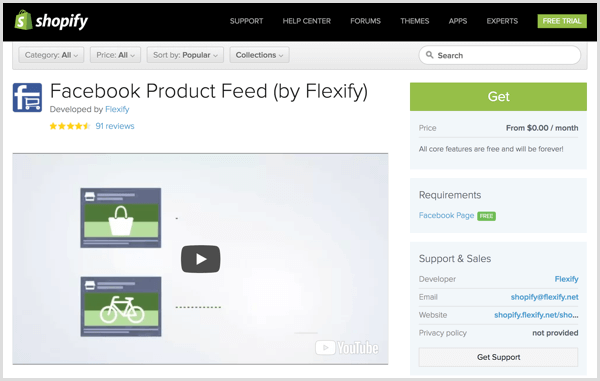
Facebook Product Feed by Flexify is free and works well for any ecommerce store with fewer than 100 products. You just need to install the plugin into your Shopify store, and then presto! Your feed can be created.

Facebook Product Feed by Flexify plugin page

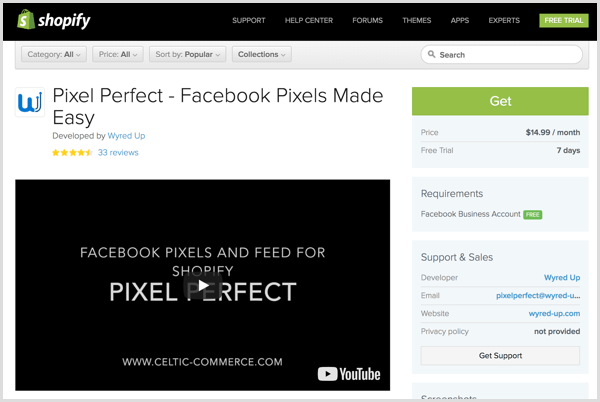
If you have more than 100 products, Flexify can get a little buggy, so you’re better off switching to Pixel Perfect (which costs $14.99 per month). Both apps do basically the same thing, but Pixel Perfect is more reliable for bigger stores.

Pixel Perfect plugin page

WooCommerce

If you have a WordPress store (WooCommerce), PixelYourSite is a great option to set up the pixel and event tracking. You need to get the Pro version when you install the plugin. It costs $80 per year, but it’s well worth it.

Once you have PixelYourSite Pro installed, you need the Pro version of PixelYourSite Product Catalog Feed, which costs $50 per year. Both PixelYourSite Pro and PixelYourSite Product Catalog Pro work together to provide everything you need to get up and running.

Other Ecommerce Setups

If you have a bespoke ecommerce platform rather than an off-the-shelf system, you have a couple of options:

  • Speak to your developers and ask them to build a product feed for your website. They can get all of the technical information they need from Facebook here.
  • Build a manual feed. A manual feed is an Excel document that contains all of the product information that Facebook needs. You then upload it to Facebook Business Manager. Manual feeds are great for smaller ecommerce stores that struggle to get product feeds built, but a drawback is that they don’t get updated when the website gets updated.

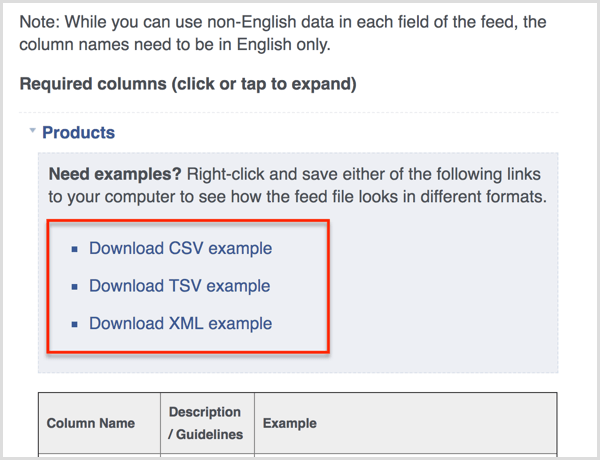
If you want to download the template for a manual feed, click the link above. There are several options depending on what format you want to use:

Facebook product feed examples available for download

Product Feed Link

When your product feed is complete (except for the manual feed), you’ll receive a link that looks something like this: https://ift.tt/2sjAHwX. Later, you’ll add this link to Facebook Business Manager so Facebook can pull the data from the feed into the system.

#3: Set Up a Facebook Catalog

The next step is to create a Facebook catalog that contains information for the items you want to advertise in your Facebook ads. The catalog can be used not only for dynamic product ads but also for carousel ads, collection ads, or any ads where you want to display your products.

What are the benefits of a Facebook catalog?

  • It will keep track of the products you sell so you can use them seamlessly with your ads.
  • It allows you to serve targeted ads to people who’ve already shown interest in your business through dynamic ads.
  • You can show off your inventory to people in a full-screen experience on mobile (collection ads).

Create the Catalog

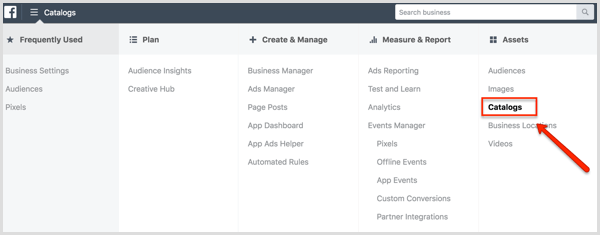
To create a catalog, open Facebook Business Manager, click the three lines in the top left to open the menu, and select Catalogs under Assets.

Catalogs link in Facebook Ads Manager

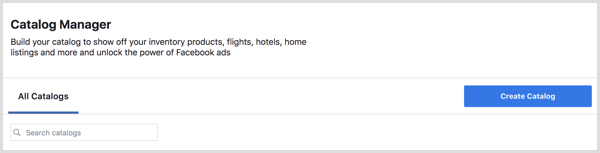
On the Catalog Manager page, click Create Catalog.

Create Catalog button in Facebook Catalog Manager

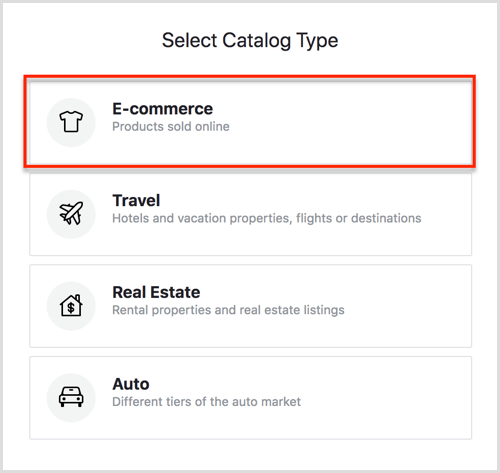
Select the relevant catalog type and click Next. In this example, select E-commerce.

Select Catalog Type options in Facebook Catalog Manager

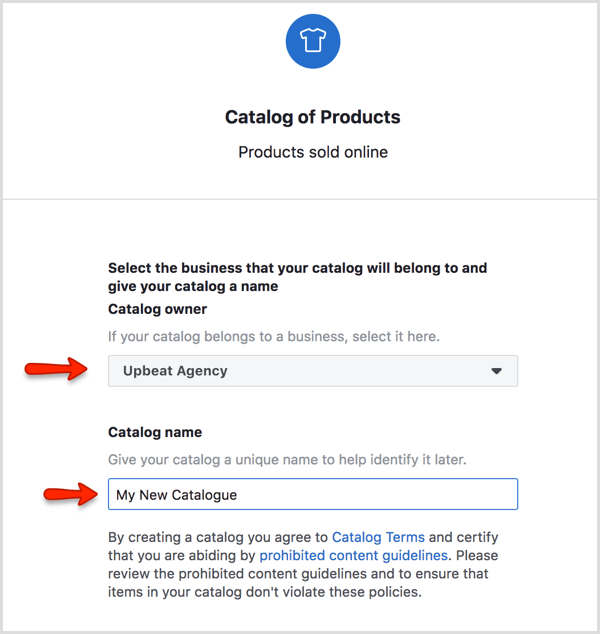
On the next screen, select your business name from the drop-down menu, add a name for your catalog, and click Create.

Select the business your Facebook catalog will belong to and give your catalog a name.
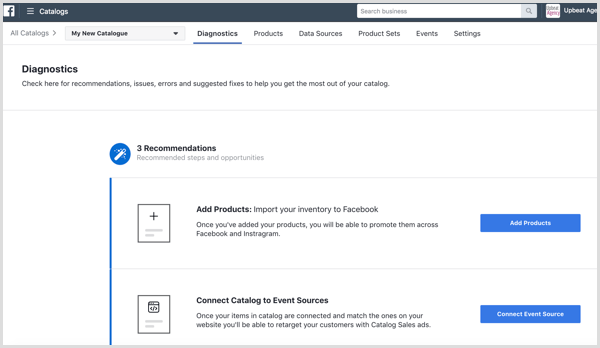
You then see a message that your catalog has been created. Click View Catalog to open the Catalog Manager homepage, which looks like this.

Facebook Catalog Manager dashboard

Set Up Product Feed

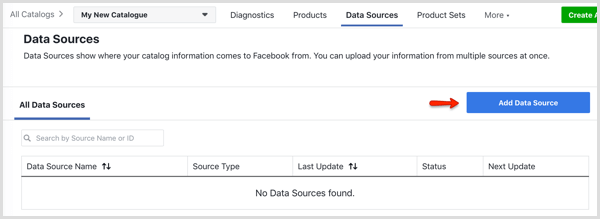
The next step is to set up your product feed. Open the Data Sources tab at the top of the page and click the Add Data Source button on the right-hand side.

Add Data Source button on Data Sources tab in Facebook Catalog Manager

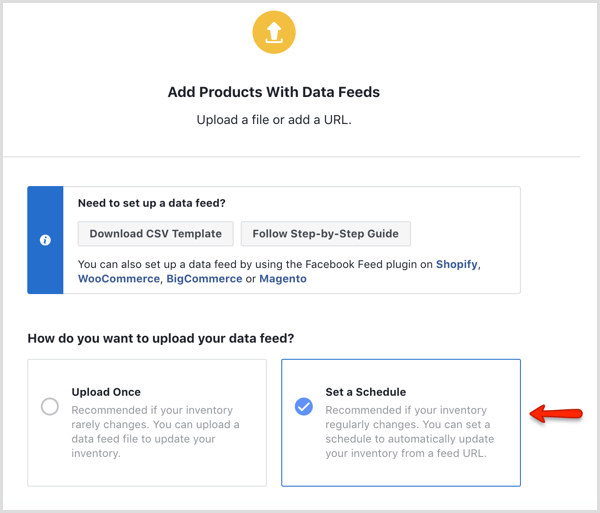
On the next page, select the Set a Schedule option. This means your feed will automatically update at a time and frequency you choose, which is important if your stock changes regularly.

Set a schedule to update your inventory from a feed URL.

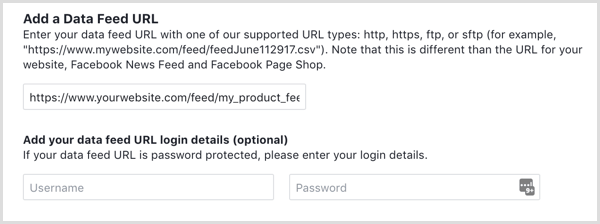
Scroll down to the Add a Data Feed URL section and paste your product feed URL in the box. (This is the URL you set up earlier.) Unless your feed is password-protected, you don’t need to enter those details.

Paste your product feed URL in the box.

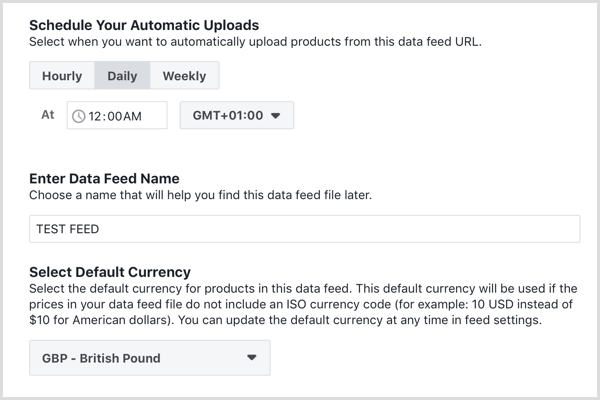
Next, decide how often you want your feed to update. For instance, you can schedule it to update every day at midnight.

Finally, enter your feed name and select the correct currency. When you’re done, click Upload.

Enter feed name and select correct currency

It may take some time for your feed to upload depending how many products you have in it. After you see a message that the upload is complete, click Done to return to the Diagnostics page, where you can troubleshoot any issues with your feed.

Connect an Event Source

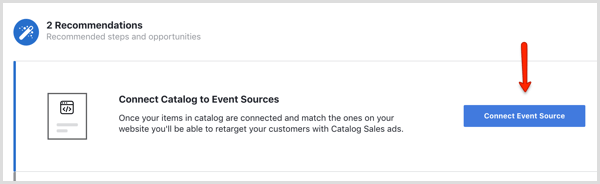
Now you need to connect an event source, which basically means telling the catalog which Facebook pixel to use. This is an important step and shouldn’t be overlooked.

Click the Connect Event Source button.

Facebook Connect Event Source button

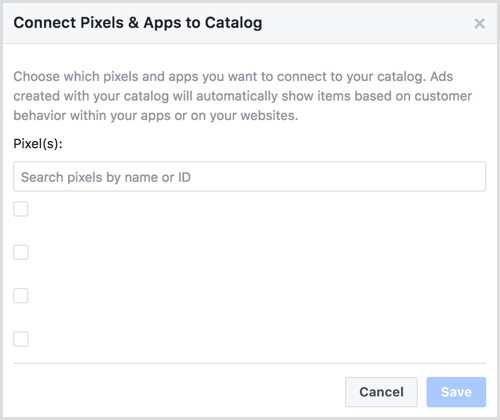
In the pop-up window, select the appropriate Facebook pixel for the project you’re working on.

Connect Pixels & Apps to Catalog dialog box

Now that you have the product catalog up and running, you can move on to build your campaign.

#4: Set Up Your Facebook Dynamic Product Ads Campaign

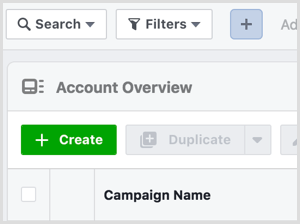
To create your campaign, open Ads Manager and click Create.

Create button in Facebook Ads Manager

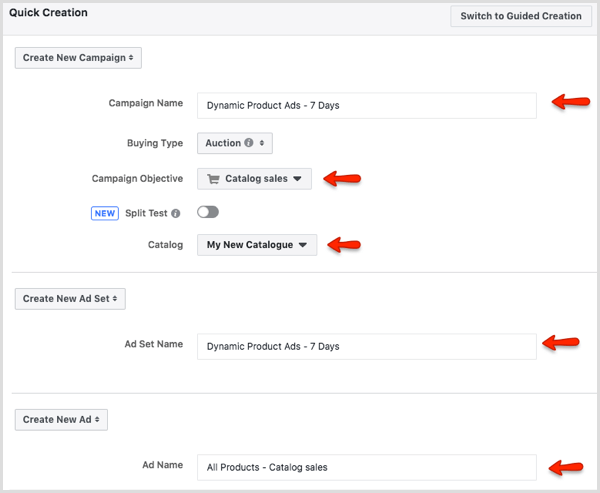
On the next page, click Select Quick Creation.

When the parameters window opens, name your campaign and select Auction as the buying type. Choose Catalog Sales as the campaign objective and choose the catalog you want to promote.

After you name your ad set and ad, click Save to Draft.

Quick Creation window in Facebook Ads Manager

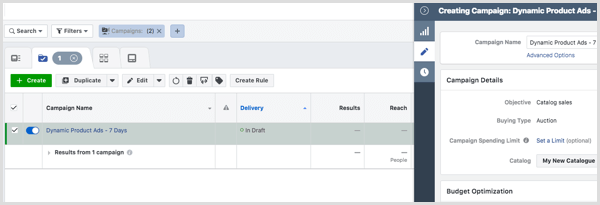
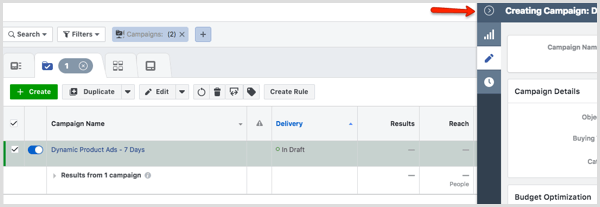
Once you click Save to Draft, the campaign shell is added to your Ads Manager, as shown here:

campaign shell in Facebook Ads Manager

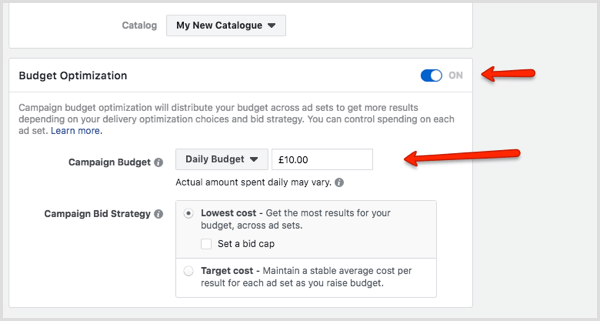
At this point, it’s a good idea to change the budget optimization. Turn on the Budget Optimization slider.

Budget Optimization section in Facebook Ads Manager

Now set your campaign budget. If you’re not sure what budget to set, around $14 (£10) a day is a good place to start, unless your website is receiving thousands of website visitors daily. In this case, your audience size would be bigger so you’d need to increase the budget to ensure you reach as many of these people as possible.

When you’re done, click the small arrow at the top right and select Close in the pop-up window to return to the main Ads Manager screen.

small arrow at the top right of Facebook campaign shell

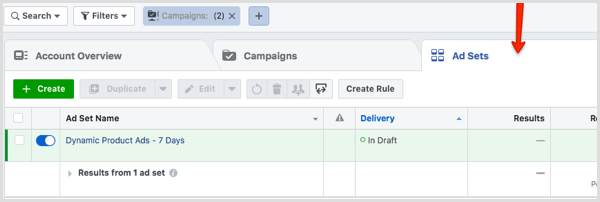
Now that you’ve edited the campaign section, you’re ready to set up the Ad Set level. Click the Ad Sets tab.

Ad Sets tab in Facebook Ads Manager

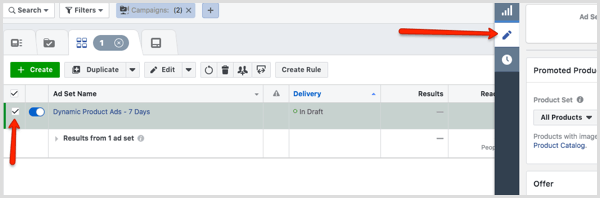
Then select the checkbox next to the Ad Set name and click the pencil icon on the right. The screen will slide out and you’ll be able to see the audience options section.

pencil icon for Facebook ad set

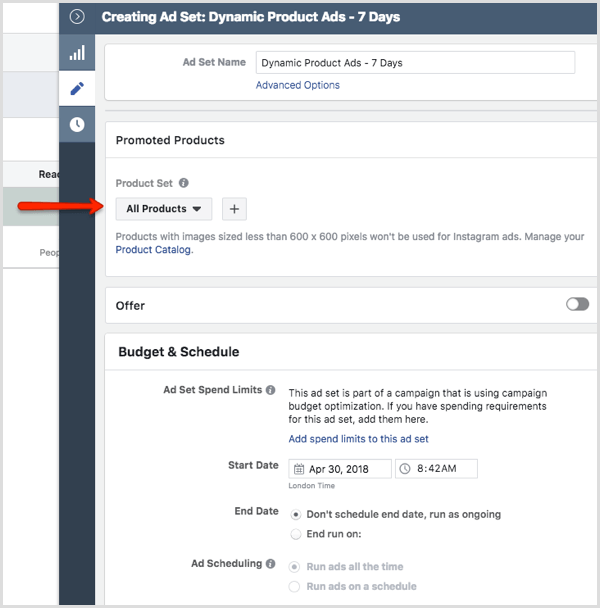
At the Ad Set level, select the products you wish to promote and set your budget and scheduling.

Promoted Products section in Facebook Ads Manager

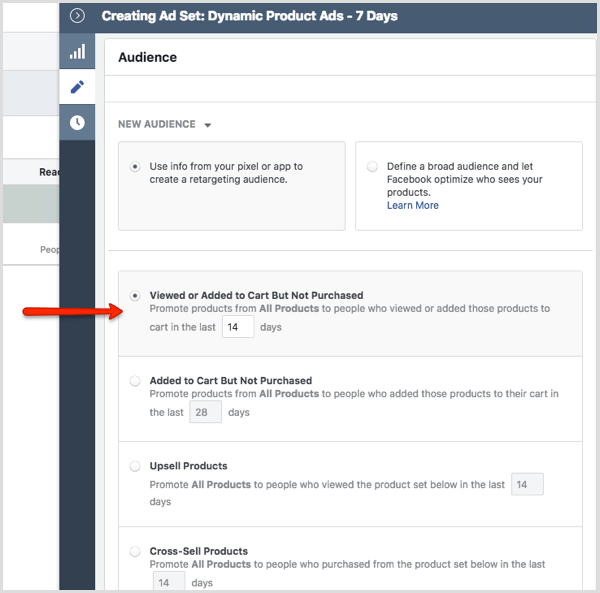
Scroll down the Audience section. When you first get started with dynamic product ads, you may want to select Viewed or Added to Cart But Not Purchased.

If you have lots of traffic coming to your website, you may want to test different options and have different messages serve different audiences depending on what events they trigger.

Audience section of ad set in Ads Manager

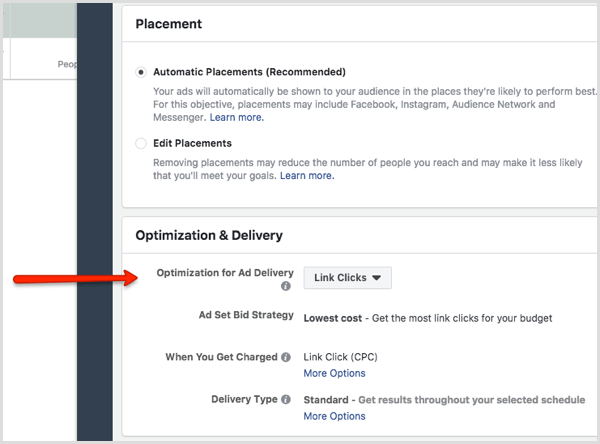
Under Placement, select Automatic Placements. For Optimization & Delivery, again it’s worth testing different options, but to get started, select Link Clicks.

Optimization for Ad Delivery section of ad set in Ads Manager

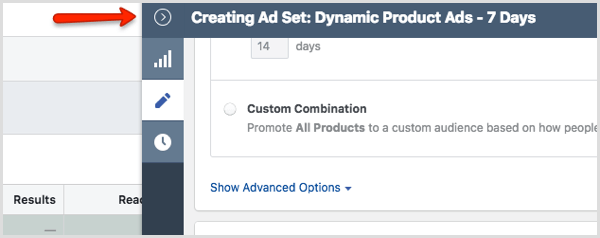
Now you’re ready to create some ads. Click the little gray arrow and click Close in the pop-up.

gray arrow for ad set in Ads Manager

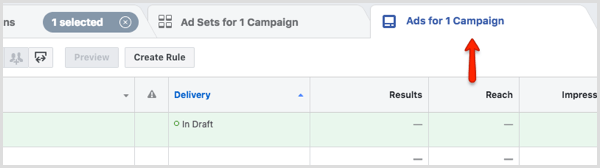
Next, click the Ads tab.

Ads tab in Ads Manager

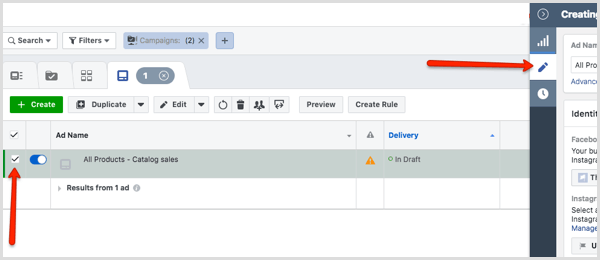
Select the ad name checkbox and click the pencil icon on the right-hand side to display the ad options.

pencil icon for ad in Ads Manager

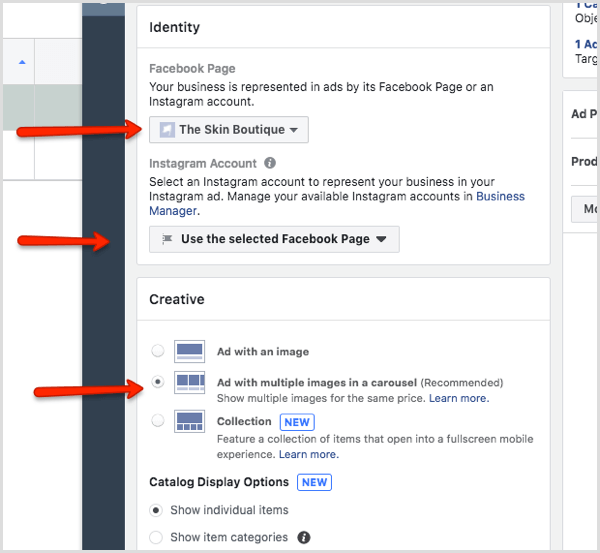
At the Ad level, first select your Facebook page. If you’re going to show the ads on Instagram, select your Instagram account. Under Creative, select Ad With Multiple Images in a Carousel.

Identity and Creative sections for ad in Ads Manager

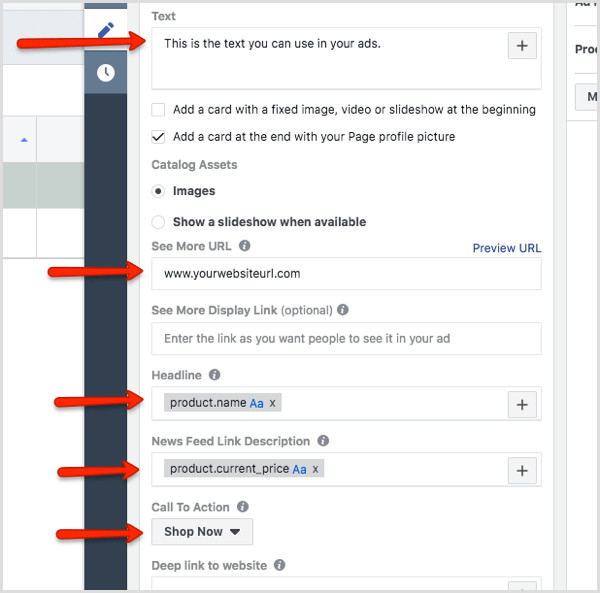
When you create a dynamic ad, the product images will be automatically pulled from your website and you can choose exactly what information about the product you’d like to show in your ads.

As you scroll down, you see a number of options for customizing your ad. This is where you can add text to your ad, select what information you want to pull from your dynamic feed, and choose your call-to-action button. You may want to test a few different things to see what works for your business and audience.

Creative section for ad in Ads Manager

When targeting people who have viewed particular products on your website, carousel ads are the recommended format because they showcase all of the products that person has previously viewed on your website.

Depending on your products, it may also be worth testing single image ads vs. carousels to see what works best for your brand. I suggest using more aggressive copy here than in previous steps to remind your target audience that the products they viewed previously are still available.

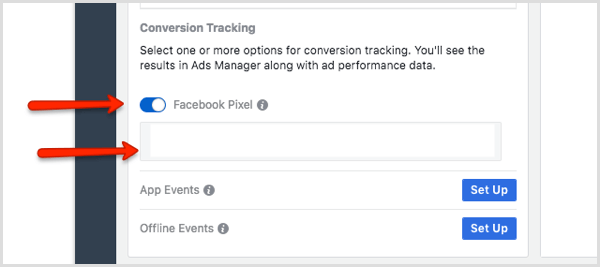
Scroll down and make sure you have your Facebook pixel selected.

Conversion Tracking section for ad in Ads Manager

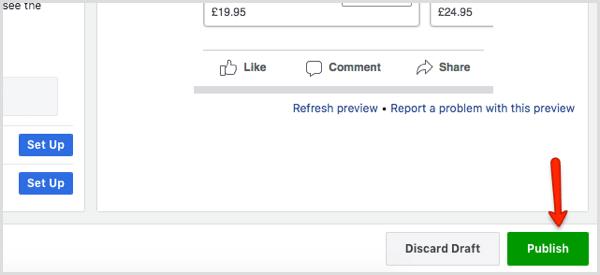
When you’re ready, click Publish.

Publish button for ad in Ads Manager

Your ads will now go into review, but should be published shortly.

Explore Catalog Manager Tabs

Let’s run through the Catalog Manager tabs so you’re familiar with what you use them for.

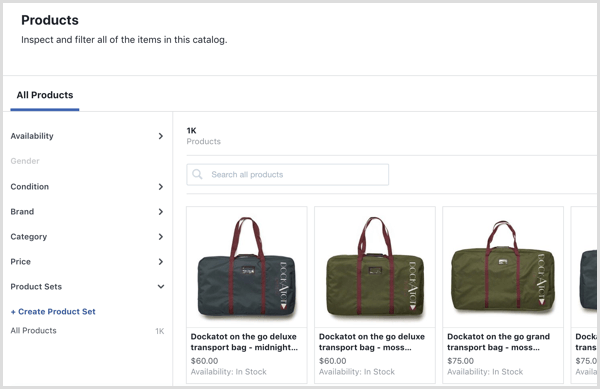
On the Products tab, you find all of your product images and information that have been pulled from your website. Review this information to ensure all of the data has transferred correctly.

Facebook Catalog Manager Products tab

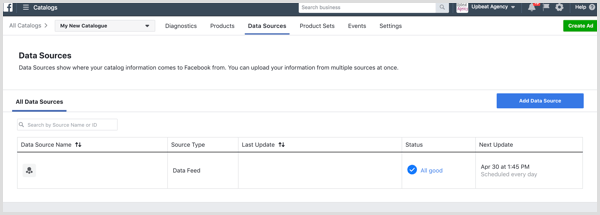
The Data Sources tab shows you where your catalog information comes to Facebook from. You can see when the next update is scheduled and view the status of your feed.

Facebook Catalog Manager Data Sources tab

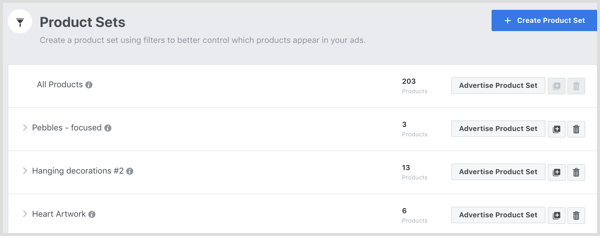
On the Product Sets tab, you can create product sets to filter which products are displayed in your ads.

Facebook Catalog Manager Product Sets tab

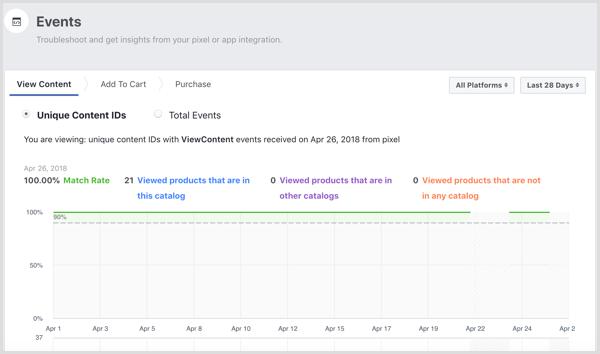
The Events tab lets you check that your catalog and your Facebook pixel events are all matching up correctly. Don’t expect this section to match up perfectly right away. Product catalogs are a little slow and when you first set them up, you need to wait at least 24 hours to get some data through.

Facebook Catalog Manager Events tab

The Settings tab is where you manage multiple aspects of your product catalog. If you have landscape or portrait (rather than square) images on your site, you may need to adjust the image transformations to prevent the images from being cropped.

Facebook Catalog Manager Settings tab

Conclusion

And there you have it! Your first dynamic product ad campaign is complete. As you’ve seen, Facebook offers lots of different options to give you the best chance of success on their platform. This guide works well for an ecommerce business, but depending on your market, products, and target audience, you may find slight variations of these recommendations are more appropriate for your business.

I recommend getting your dynamic product ads up and running for a week so you can get some data into the ad account. Then test some new options with a fresh campaign to see what works best.

What do you think? Have you used dynamic product ads? Were you happy with the results? Let us know in the comments below.

Learn how to retarget website visitors with ads for products they viewed but didn't purchase, via dynamic product ads for Instagram and Facebook.


Social Media

via https://ift.tt/1LtH18p

May 28, 2018 at 05:09AM
0 Comments

Facebook Testing Influencer Marketing Search Engine

5/26/2018

0 Comments

 
https://ift.tt/2EDu1OU

Facebook Testing Influencer Marketing Search Engine

https://ift.tt/2IQjClt

social media researchWelcome to this week’s edition of the Social Media Marketing Talk Show, a news show for marketers who want to stay on the leading edge of social media.

On this week’s Social Media Marketing Talk Show, we explore Facebook testing a search engine for influencer marketing, Instagram’s new Mute option, and other breaking social media marketing news of the week!

Watch the Social Media Marketing Talk Show

If you’re new to the show, click on the green “Watch replay” button below and sign in or register to watch our latest episode from Friday, May 25, 2018. You can also listen to the show as an audio podcast, found on iTunes/Apple Podcast, Android, Google Play, Stitcher, and RSS.

For this week’s top stories, you’ll find timestamps below that allow you to fast-forward in the replay above.

Facebook Tests New Search Engine for Influencer Marketing: Facebook is working on a new Branded Content Matching search engine to help advertisers find page owners with “fans they want to reach, see stats about these audiences, and contact them to hammer out deals.” A spokesperson from Facebook explains to TechCrunch that the company wants “to help businesses find creators who can reach their target audience in an authentic way while allowing creators a path to monetize their Facebook content and fan base.” The new tool is currently being tested with a set of lifestyle brands and creators. (5:05)

This tool could by Facebook’s next money-maker https://t.co/F3LIBxX77g

— TechCrunch (@TechCrunch) May 18, 2018

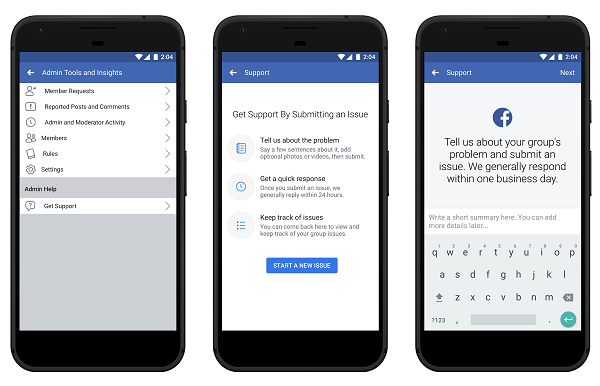
Facebook Enhances Admin Resources and Support for Groups: Facebook rolled out “several updates to help admins keep their groups safe and manage them more efficiently.” These new tools include more timely and personalized help from Facebook on issues, a new online learning destination with tutorials, product demos, and case studies for group admins, preapproval on content, and a quick and simple way to notify members when they’ve violated a rule. The latter also allows admins and moderators to collaborate by adding notes in their admin activity log about when and why they removed a post. (12:23)

Facebook enhances admin resources and support for groups.

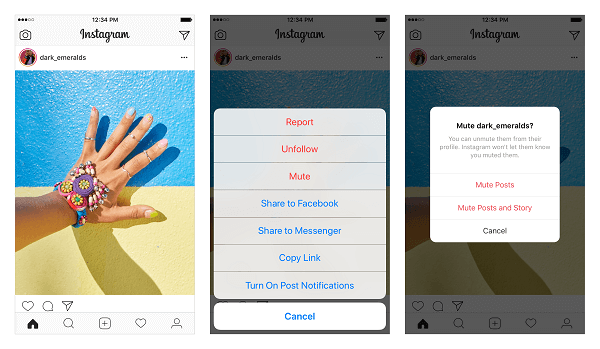
Instagram Introduces Muting: Instagram added the option to hide posts or both posts and stories from certain accounts without having to unfollow them. This new feature is rolling out “over the coming weeks.” (20:23)

ALT TEXT

Instagram Tests “All Caught Up” Alert: TechCrunch reports that Instagram is showing some users a mid-feed alert that states “You’re All Caught Up – You’ve seen all new posts from the past 48 hours.” Instagram hasn’t yet provided details on how this new feature works nor confirmed if this means that Instagram has shown you every post from people you follow or simply the ones served by the algorithm. This new feature is currently being tested with a select group of Instagram users. (25:50)

Instagram says “you’re all caught up” in first time well spent feature https://t.co/ckFu1WBCaw by @joshconstine pic.twitter.com/PHqiIdhH0S

— TechCrunch (@TechCrunch) May 21, 2018

Instagram Organic Posts Can Now Be Turned Into Ads: Facebook is rolling out a new feature that allows Instagram advertisers to turn existing organic Instagram posts into ads within Facebook Power Editor and Ads Manager. Advertisers will have access to Brand Awareness, Post Engagement, Reach, and Video Views objectives and be able to purchase the ads in “auction buying.” However, they’ll only be able to create an ad from an individual video and photo post for now. Carousel, Stories, Branded Content, and Instagram Shopping posts are currently not supported. This new feature is rolling out to “all global advertisers” within the “next few weeks.” (30:07)

You don’t have to use the “Promote” button on Instagram to turn organic posts into ads anymore. You can simply use Facebook’s ads interfaces. https://t.co/fquAXLWkAJ

— We are Social Media (@WeRSM) May 23, 2018

YouTube Tests Algorithmic Subscription Feed: YouTube confirms it’s replacing the reverse chronological order in which videos are served in the Subscriptions feed with an algorithm that “personalizes” the feed. This update is being tested with “some users” and appears to use a viewer’s watch history and other factors to recommend videos that the company thinks they’ll want to watch. This is similar to the way Facebook, Instagram, and Twitter show posts and updates.

Just to clarify. We are currently experimenting with how to show content in the subs feed. We find that some viewers are able to more easily find the videos they want to watch when we order the subs feed in a personalized order vs always showing most recent video first.

— Team YouTube (@TeamYouTube) May 23, 2018

Twitter Introduces the Twitter Timeline Ads Pilot Program for Publishers: Twitter launched a pilot ad program called Twitter Timeline Ads. This new program allows publishers to generate revenue for their site with ads shown in embedded timelines. According to an email sent to publishers and shared by Matt Navarra, Twitter states it has “hand selected a small group of publishers” in the U.S. for this invite-only program. Other publishers can sign up on the Twitter Business site to find out more about the program.

Here’s more detail about Twitter’s NEW timeline ads product for publishers pic.twitter.com/rSltSm8oZb

— Matt Navarra (@MattNavarra) May 22, 2018

Twitter Shuts Down TV Apps: This week, Twitter announced that its TV apps, Twitter for Roku, Twitter for Android TV, and Twitter for Xbox, will no longer be available. A spokesperson for Twitter cites “…compliance with the General Data Protection Regulation,” which also goes into effect this week as its reason for shuttering the three apps.

On Thursday, May 24, Twitter for Roku, Twitter for Android TV and Twitter for Xbox will no longer be available. To get the full Twitter experience, visit https://t.co/fuPJa3nVky on your device or desktop.

— Twitter Support (@TwitterSupport) May 22, 2018

Twitter Updates Mobile Web, Lite, and Windows Versions: Twitter’s mobile web version, Twitter Lite, and Twitter for Windows now support night mode; real-time updates on replies, likes, and retweets; and a newer tweet compose window.

We are rolling out the following features to https://t.co/AIUgyCj4rs, Twitter Lite, and Twitter for Windows to provide more consistency across platforms. See what’s new. ?

✔ night mode
✔ real time updates on reply, Retweet, and like counts
✔ updated Tweet compose box

— Twitter (@Twitter) May 22, 2018

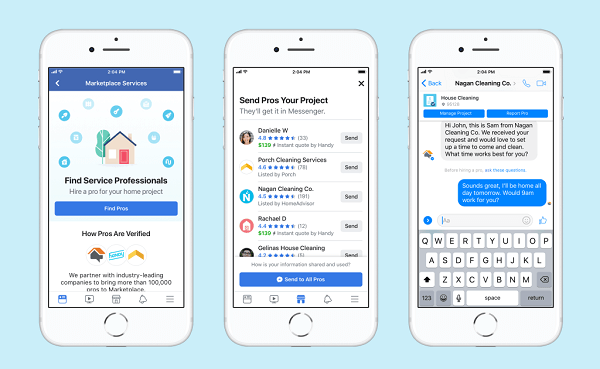
Facebook Marketplace Expands to Include Home Services in the U.S.: Facebook Marketplace listings will now include thousands of “top-rated and vetted” local home service professionals such as house cleaners, plumbers, contractors, and more. This new tool is powered by data from third-party partners Handy, HomeAdvisor, and Porch, and gives users access to the professionals’ ratings, reviews, credentials, and location. It also enables users to receive instant quotes on jobs. Facebook is rolling out this new feature to all Facebook app users in the U.S. over the next few weeks.

Facebook Marketplace listings will now include thousands of top-rated and vetted local home service professionals such as house cleaners, plumbers, contractors, and more.

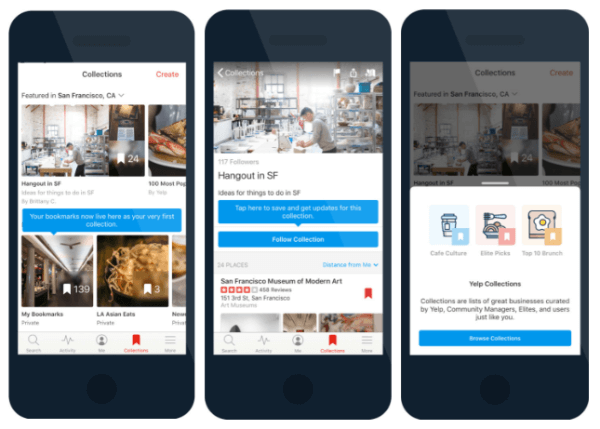
Yelp Rolls Out Collections: Yelp rolled out Collections, which delivers “fresh, up-to-date content that helps connect you with great local businesses.” With this new feature, new businesses and top recommendations from across the Yelp community will be served as personalized recommendations based on an individual’s activity on Yelp. Yelp will also provide curated collections and enable users to create personal collections.

Yelp rolled out Collections, which delivers fresh, up-to-date content that helps connect you with great local businesses.

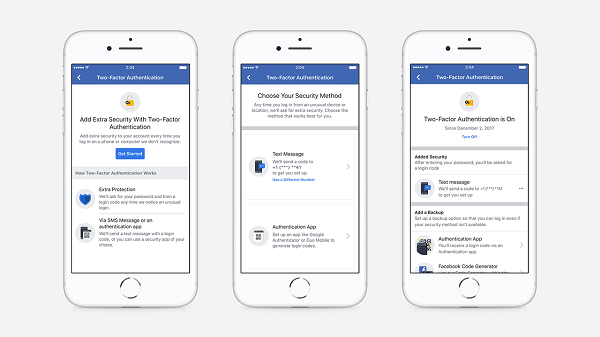
Facebook Two-Factor Authentication No Longer Requires Phone Numbers: Facebook streamlined the setup flow that enables users to establish two-factor authentication and eliminated the need to register a phone number to secure an account. Facebook previously required a phone number to set up two-factor authentication and prevent lock-outs but has redesigned the process to make it easier to use third-party authentication apps such as Google Authenticator and Duo Security on both desktop and mobile.

Facebook streamlined the setup flow that enables users to establish two-factor authorization and eliminated the need to register a phone number to secure an account.

Facebook Asks Users to Clarify Privacy and Data Preferences: After being asked to provide a clearer explanation of what information it collects and how it uses this data, Facebook is popping up news feed alerts that ask users to review their preferences and details around advertising, face recognition, and information they’ve chosen to share in their profile. Facebook previously updated its data policy and made its privacy controls easier to find. These tools were initially required by the European Union in preparation of the General Data Protection Regulation (GDPR) deadline but Facebook expanded them worldwide.

Want to catch our next show live? Click here to subscribe or add our show to your calendar.


Social Media

via https://ift.tt/1LtH18p

May 26, 2018 at 05:09AM
0 Comments

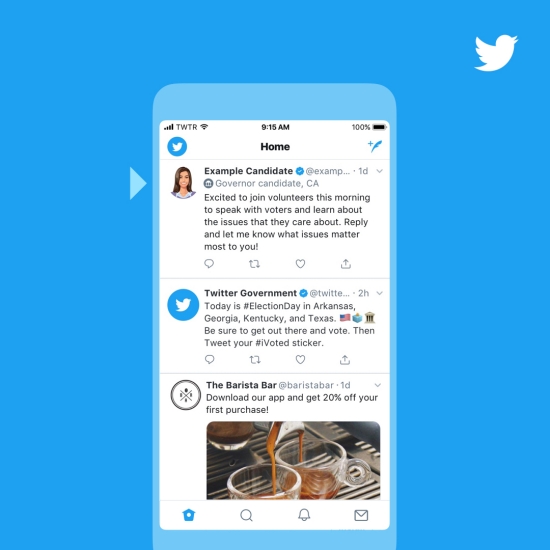
Twitter will give political candidates a special badge during US midterm elections

5/25/2018

0 Comments

 
https://ift.tt/2KVYRp4

Twitter will give political candidates a special badge during US midterm elections

https://ift.tt/2sfkMzI

Ahead of 2018 U.S. midterm elections, Twitter is taking a visible step to combat the spread of misinformation on its famously chaotic platform. In a blog post this week, the company explained how it would be adding “election labels” to the profiles of candidates running for political office.

“Twitter has become the first place voters go to seek accurate information, resources, and breaking news from journalists, political candidates, and elected officials,” the company wrote in its announcement. “We understand the significance of this responsibility and our teams are building new ways for people who use Twitter to identify original sources and authentic information.”

These labels feature a small government building icon and text identifying the position a candidate is running for and the state or district where the race is taking place. The label information included in the profile will also appear elsewhere on Twitter, even when tweets are embedded off-site.

The labels will start popping up after May 30 and will apply to candidates in state governor races as well as those campaigning for a seat in the Senate or the House of Representatives.

Twitter will partner with nonpartisan political nonprofit Ballotpedia to create the candidate labels. In a statement announcing its partnership, Ballotpedia explains how that process will work:

Ballotpedia covers all candidates in every upcoming election occurring within the 100 most-populated cities in the U.S., plus all federal and statewide elections, including ballot measures. After each state primary, Ballotpedia will provide Twitter with information on gubernatorial and Congressional candidates who will appear on the November ballot. After receiving consent from each candidate, Twitter will apply the labels to each candidate profile.

The decision to create a dedicated process to verify political profiles is a step in the right direction for Twitter. With major social platforms still in upheaval over revelations around foreign misinformation campaigns during the 2016 U.S. presidential election, Twitter and Facebook need to take decisive action now if they intend to inoculate their users against a repeat threat in 2018.


Social Media

via Twitter – TechCrunch https://techcrunch.com

May 25, 2018 at 06:28PM
0 Comments

Please enjoy this Instagram account that hilariously reimagines your favorite album covers

5/25/2018

0 Comments

 
https://ift.tt/2kr7OLG

Please enjoy this Instagram account that hilariously reimagines your favorite album covers

https://ift.tt/2xfgrlS


With every photo, there's always more than meets the eye. 

Thankfully, there are good folks like Russian-based artist Igor Lipchanskiy who are here to help us expand what we think we know — at least when it comes to album covers. 

Lipchanskiy takes the album art of artists like Prince or will.i.am and adds his own interpretation of what exactly might be happening beyond the perimeters of the square image. 

The first album posted on Lipchanskiy's Instagram account is from June 2017, in which he recreates the cover for the Arctic Monkey's album Whatever People Say I Am, That's What I'm Not. 

Since then, Lipchanskiy has played with iconic album covers — and nothing is sacred. 

He bounces between recent releases and classics, creating a specific world for each of the albums.   

"I have decided to make a small selection of interesting covers and show what might be off-screen if I were there," the artist explained on Bored Panda. 

Despite the seriousness of some albums, almost all recreations are treated with humor. 

Some even address current pop culture moments, like everyone's favorite "I don't feel so good..." memes.  

You can see more of Lipchanskiy work and suggest future album covers for him here. 


Social Media

via Social Media https://ift.tt/2DCFv97

May 25, 2018 at 11:57AM
0 Comments

Irish people are pouring in from across the globe to vote in a 'once in a generation' abortion referendum

5/25/2018

0 Comments

 
https://ift.tt/2KPzrJy

Irish people are pouring in from across the globe to vote in a 'once in a generation' abortion referendum

https://ift.tt/2J7C6RC


Irish people are pouring in from across the globe to vote in a 'once in a generation' abortion referendum

Maria Dermentzi 7 minutes ago

Irish expats are traveling from all across the world to go #HomeToVote in the abortion referendum. 


Social Media

via Social Media https://ift.tt/2DCFv97

May 25, 2018 at 10:36AM
0 Comments

How to Improve the Profitability of Your Small Business Mobile App

5/25/2018

0 Comments

 
https://ift.tt/2J2CXmK

How to Improve the Profitability of Your Small Business Mobile App

https://ift.tt/2xfagyk

If you have been following the latest marketing developments, you know everything is trending in a mobile direction.

Consumers are seemingly glued to their phones and tablets. In fact, 77% of adults in the United States own a smartphone. That number is up from 35% in 2011.

That’s why it’s so important for you to optimize your web design for mobile users. While this is a necessary approach, it’s not enough if you really want to enhance your mobile marketing strategy.

The way people use their phones has changed. People don’t consume information the way they did five or ten years ago.

With the rise in smartphone usage, it makes sense that there is also a growing popularity in mobile app usage.

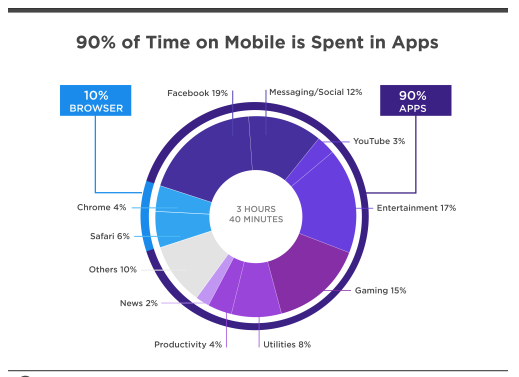
In fact, 90% of mobile usage time is spent on applications.

image4 7

If you are one of the small business owners who recognized this trend and built a mobile app, congratulations.

Developing an app is no easy task, and it’s definitely not the least expensive investment you’ll make in your lifetime. But now that your app has launched, you might be having some concerns about your return on investment.
You expected to see massive profits right off the bat, and that’s not always the case.
Some of you may have had your small business mobile app out for a while now. At first, it was performing well, but over time sales have become stagnant or even declined.
Even if your mobile app is successful, there is always room for improvement. That’s the inspiration for this guide.

I’ll explain everything you need to know about optimizing your small business mobile app to maximize sales and increase profitability. Here’s what you need to know.

Don’t charge users to download your app

I know what you’re thinking. How can you make money with a free mobile app?

Charging an upfront fee for downloads may seem like an appealing way to get some fast cash. It could be the way you forecasted getting your initial investment back. But I advise against this strategy.

As a small business owner, you know how important it is to prioritize customer service. You also know how cost-sensitive your customers are.

The investment to download your app will turn people away. Even if you’re only charging a few bucks, it’s just not worth it to people.

Why?

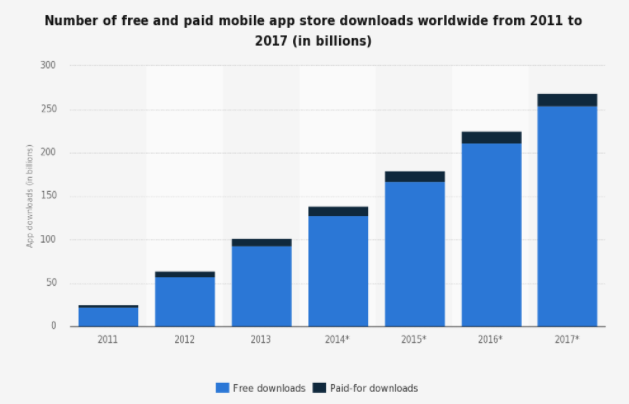
Well, for starters, your customers are not used to paying for their apps. Research shows the vast majority of mobile app downloads are free.

image2 7

Is your app really that much more valuable to the user than all the other free apps on their device? I doubt it.

Removing the cost to download an app will ultimately result in more downloads. Now people won’t have a reason to hesitate when installing your app on their devices.

The more people download your mobile app to their smartphones and tablets, the greater the chances of them spending money.

Here’s another way to think of it. If you’re using this app as a platform to sell your products, what’s the cheapest item offered on your app?

Now, compare that to the cost you were considering charging for a one-time download. It’s just not worth it to collect an insignificant fee when you can cover these user acquisition costs with actual purchases instead.

Focus on app store optimization (ASO)

Since you’ve already developed a mobile app for your business, I’ll assume you’re somewhat tech-savvy.

Even if you didn’t build it yourself, you at least have your finger on the pulse when it comes to the latest technology. You probably have a website and understand the basic principles of search engine optimization (SEO).

Well, app store optimization is basically the same concept. But it’s in reference to the app store as opposed to an Internet search engine.

There are certain elements based on how you set your app up that will affect your ranking in the app store.

However, there’s a catch. These algorithms and factors will differ depending on where your app is available. The two biggest app stores are the Google Play Store for Android devices and the Apple App Store for iOS devices.

Those of you who have your app available on both platforms, which I definitely recommend, need to understand how these elements affect your ranking.

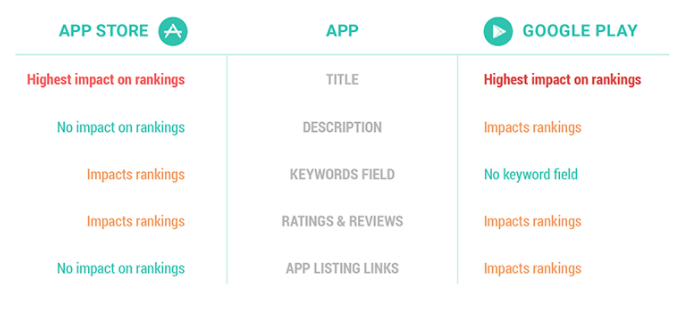
Here is a look at some of the main differences between these two app stores:

image3 7

As you can see, there are definitely some similarities between the two stores that have implications for your ASO strategy. The app title in both the Apple App Store and Google Play Store has the most significant impact on your search rankings.

The way user reviews and ratings impact your search ranking is also similar on both platforms.

However, some of the key differences here include:

  • description
  • keywords field
  • app listing links

You’ll need to make changes to your listing in each store so that it’s appropriately optimized for ASO.

If you have your app available only in one store, you’re missing out on a huge opportunity here. Alienating a large percentage of your customers is costing you money.

Once you have your app offered in both app stores and prioritize your ASO, you will see more downloads.

As I have previously stated, increased downloads will improve profitability.

Personalize the user experience

What happens when someone downloads your app?

Think about what everyone sees on your homepage and interface. Is it the same?

If the answer to that question is yes, you’re making a mistake. You should encourage app users to create a customer profile when they launch your app.

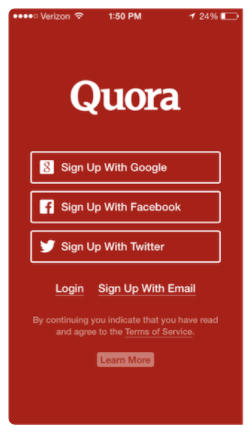
Often, people are turned off and discouraged by the time-consuming and tedious process of creating a profile. You can make it easier for your customers by integrating your app with their Facebook profile or Google accounts. This simplifies the login process.

Here’s an example from the Quora app that illustrates exatly what I’m referring to.

image1 7

This is much easier for your users than having to type in all of their information to set up a profile.

But now that they have an account with your app, every action they make can be tracked to enhance their personalized experience.

Based on things such as their search history and previous transactions, you’ll be able to recommend appropriate products and services to each customer.

You can also recommend items based on age, location, gender, etc. Tracking previous purchases makes it easy for customers to complete repeat orders.

All of these factors will help you drive sales and boost profits through your app.

Personalized offers encourage customers to spend more money. In fact, 39% of customers are willing to spend more after receiving personalized mobile promotions.

Use your app to enhance the in-store experience

I know that some small businesses operate exclusively online. So this tactic may not apply to you at the moment.

But I still encourage you to review this section in case you expand your company to physical locations in the future.

But if you have brick and mortar retail locations, your app can help complement the in-store buying process for your customers. How well have you been tracking your customers’ shopping habits?

If you watch them closely, you may have realized they are already using their smartphones while they are shopping in your store.

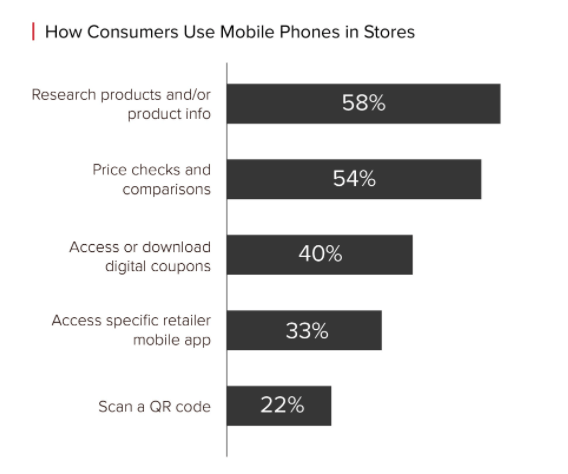
You might as well integrate your mobile app with your physical store to make shopping even easier for your customers. These are the top ways that customers use their phones while shopping in stores:

image5 7

Your app should be able to do all the things on this list.

Make it easy for customers to scan a barcode of an item in your store directly from your mobile app platform. Now they’ll have access to a detailed product description and be able to read user reviews.

Give them an option to save items in a list of their favorites so they can buy it later, even if they don’t want to buy it right now.

This will make it easier and more appealing for them to complete the transaction.

On the flip side, they can browse for an item on your app and save it in their favorites list before they get to your store. When they arrive, your app can tell them exactly where the product is located in the store.

Now they can check it out in person to make sure it’s exactly what they had expected before buying it. This really enhances the customer experience.

As we previously discussed, you want to personalize the customer experience.

Your mobile app can also act as a customer identification card for each user. This will be linked to their account and loyalty rewards program. We’ll discuss this concept in greater detail shortly.

Send push notifications

Your mobile website is a great asset to your small business. But one thing it can’t do is contact your customers at will.

Since you have a mobile app, you need to use push notifications to your advantage and reach out to your customers.

You just need to be cautious when it comes to the type of message you’re sending with each push notification.

We know that 48% of app users want to receive push notifications about special offers based on their preferences. This relates back to one of my earlier points about personalization.

Just don’t send push notifications too frequently. That’s because 52% of users believe that push notifications are an annoying distraction. You don’t want your company to be perceived as annoying. Sending too many notifications can cause damage beyond your brand’s tarnished reputation.

For example, 32% of app users will stop using an app altogether if they get too many notifications.

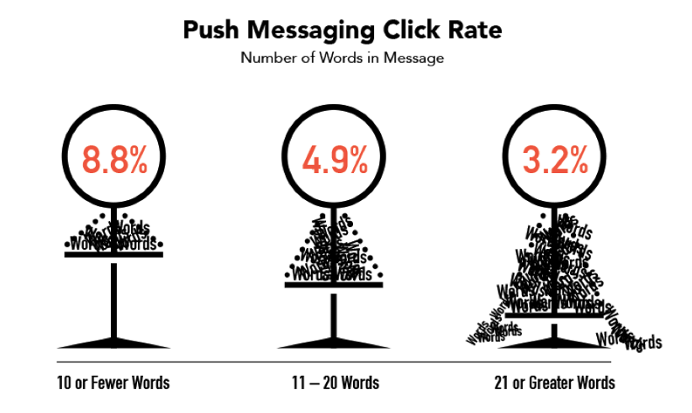
You should also consider the word count of your push notifications.

image6 7

If you have too many words, they may not fit on the screen. This will obviously have a negative impact on your open rates.

That’s why push notifications with ten or fewer words have the highest click rates.

When it comes to your push notification strategy, your best bet is to only send messages that add value to the recipient. I’d recommend discounts or promotions to get started.

Timely notifications are helpful as well. If your company is delivering something to the customer, such as food, a notification “your food has arrived” would definitely be appropriate.

Just don’t go overboard with these, or users can turn off notifications. If that happens, it won’t help you generate more profits.

Set up a loyalty program

You don’t always need to turn to new downloads and user acquisition to make more money. Instead, look at your most loyal customers as a way to increase profits.

As I mentioned earlier, your mobile app can act as a digital customer loyalty rewards card. We’ve all seen these before. Your small business may even have one of these systems already in place.

I’m talking about things such as a simple punch card. For example, if you have a sandwich shop, you may offer a free sandwich on the customer’s 10th visit.

The problem with this system is that cards get misplaced, and it’s not easy to track the purchases. But a mobile customer loyalty program is much more effective.

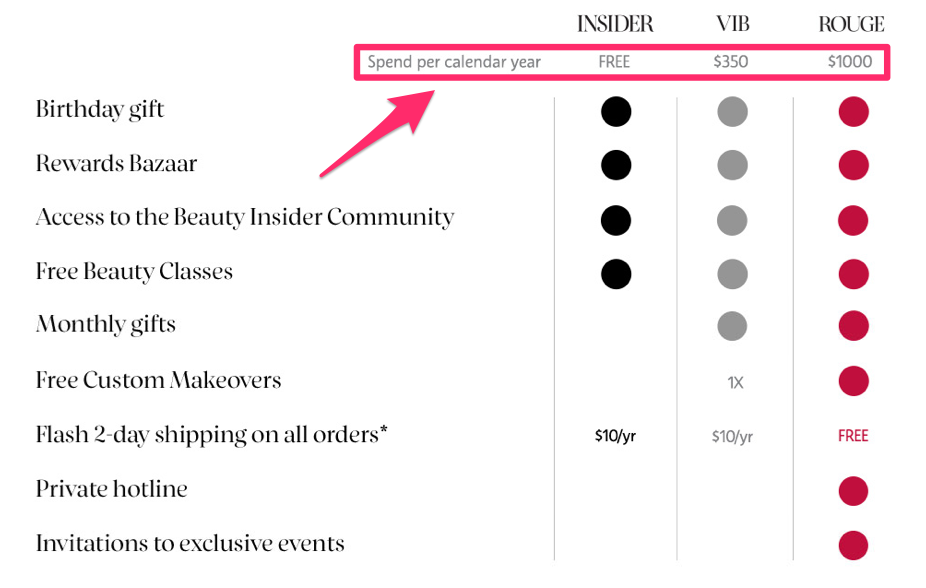
You can set it up based on the number of visits, but I’d recommend taking your strategy to the next level. If two customers each make ten purchases, does that mean they are equal?

Not if one spends $100 total and the other spends $1,000 total. Setting up your rewards program based on a spending threshold system rewards your top customers.

Here’s a look at how Sephora implemented this strategy based on a customer’s annual spending:

image9 2

Adding this feature to your mobile app will help increase the buying frequency and average purchase order for each user.

That’s because customers are encouraged to spend more money so that they can reach the next level. Once they get to a new threshold, their benefits will increase.

As a result, you’ll see higher profits and improve your customer retention strategy at the same time.

Encourage user referrals

As I just finished saying, you don’t always need new customers to improve your profits. That said, it certainly helps.

A great way to get new downloads is by leveraging your relationships with your current customers. Encourage them to refer their friends and family to your app.

However, this is easier said than done. Simply asking your existing users to refer others probably won’t be enough to get the job done.

Sure, your app may be great, but it’s not enough for someone to help you just out of the kindness of their heart. They’ll be expecting something in return.

Reward customers for their referrals. Give them an incentive, such as a discount off their next purchase.

You can reward the referred user as well. It may seem as if you’re giving away too much, but it’s worth it in the long run since you’ll be getting new customers.

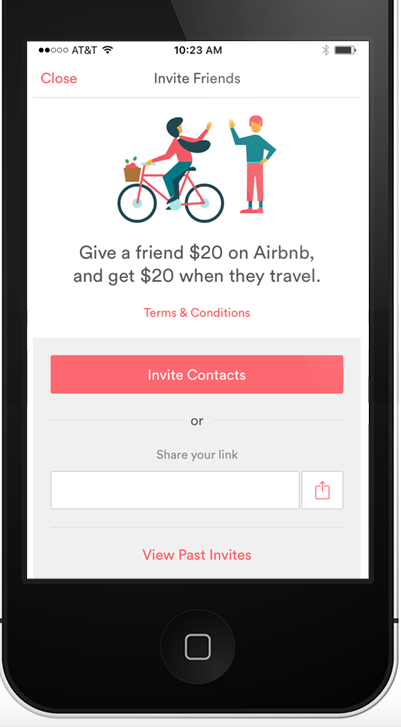
Here’s a look at how this feature looks on the Airbnb app:

image8 6

Research shows that this referral tactic helped boost their app download rates by 300%.

It’s safe to say it’s a winning strategy. It can also create an exponential download effect.

That’s because each time a new user downloads the app, they’ll also be encouraged to invite their friends to join.

This is one of my favorite ways to get your customers to recommend your brand to others.

Optimize the checkout process

Let’s continue our discussion of customer profiles. You want to take full advantage of this feature.

Once the customer makes an initial purchase through the app, you can save all of their information to their account.

Now you have their shipping address and billing information. Unlike on a desktop or mobile site, they don’t have to enter this information each time they want to buy something.

All they have to do is click on what they want and finalize the transaction. The entire checkout process can be completed in a couple of clicks.

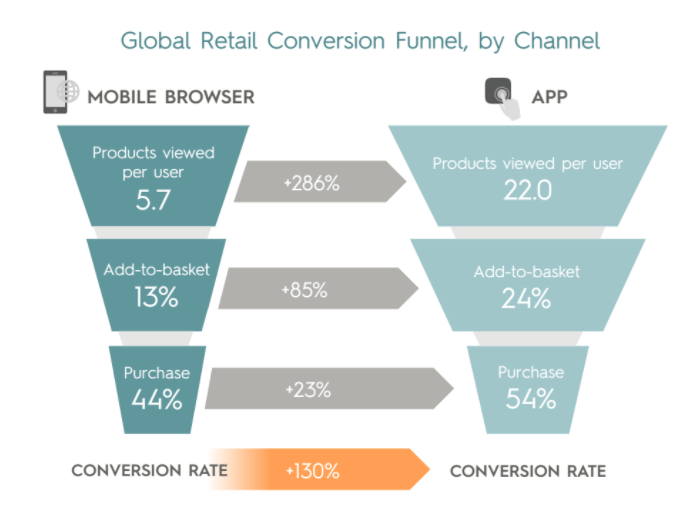
That’s why mobile apps have higher conversion rates than mobile websites:

image7 7

Do everything possible to make your app’s checkout as smooth as possible.

Fewer steps and less friction to complete a purchase will help drive sales. Plus, your app makes it easy to accept alternative payment options, such as Apple Pay.

Constantly monitor the performance

Nobody’s app is perfect.

Sure, you spent the time to make sure it was good enough before you released it, but there is always room for improvement.

Prioritize speed. Avoid glitches. Fix crashes and errors as soon as possible. It will help improve the user experience.

Research found 48% of app users are less likely to use an app if they have a poor experience. And 31% of people say they are less likely to buy something from a company based on a poor app experience. You can’t afford to overlook that.

Read through your user reviews to see the feedback and what needs to be changed.

Use beta testers to help you get valuable insights before releasing new versions and updates.

Conclusion

If your small business has a mobile app, you are already on the right path to success. But if your app isn’t generating high profits, it can feel as if there is a hole burning in your pocket.

One of the best ways to improve your app’s profitability is by finding ways to get more downloads. Ultimately, downloads will translate to dollars.

Make sure you offer your app as a free download. Focus on app store optimization to improve your search rankings in both stores. Encourage users to invite their friends through a referral program.

Personalize the user experience. Use your app to improve the way they shop in your physical stores. Set up a mobile loyalty program, and send promotions through push notifications.

Simplify your checkout process so it’s easy for app users to make a purchase.

If you follow these tips, your small business mobile app will turn into a money-making machine.

How are you using your small business mobile app to drive sales and increase profits?


Social Media

via Quick Sprout https://ift.tt/UU7LJr

May 25, 2018 at 10:05AM
0 Comments

Blue Ivy is here to make sure her grandma follows the rules

5/25/2018

0 Comments

 
https://ift.tt/2xbVJn1

Blue Ivy is here to make sure her grandma follows the rules

https://ift.tt/2IJlzUN

Blue Ivy is here to make sure her grandma follows the rules

Image: Lester Cohen/Getty Images for NARAS

2017%2f10%2f20%2fa0%2fchloebryan11.0b114By Chloe Bryan2018-05-25 14:22:21 UTC

Please do not break the rules of the ballet on Blue Ivy's watch.

As a cool celebrity, Blue is on a trip to France at the moment. And on Thursday, she took a trip with her grandmother, Tina Lawson, to a ballet performance in Paris. 

Lawson (who is notably great at Instagram) grabbed a video of the beautiful theater. As she takes footage of the ornate ceiling, you can hear Blue's voice in the background: "You're not supposed to take videos, Grandma."

Damn. Busted.

To be fair, it would be a real tragedy to get kicked out before the ballet even started. On the other hand, are they really gonna kick out two members of America's royal family?

Still, we appreciate Blue's adherence to the rules. May we all think of her moral fortitude next time we want to take a Boomerang of the Solo credits or whatever.


Social Media

via Social Media https://ift.tt/2DCFv97

May 25, 2018 at 09:36AM
0 Comments
<<Previous
Forward>>

    Amazing WeightLoss

    Click Here!

    Categories

    All
    Analyze Top Competitors
    Anti-Abuse
    Apple
    Apple Watch
    Blog Posts
    Brainstorm
    Brand Awareness
    Communications
    Content Marketing
    Conversion Rates
    Editorial Calendar Tips
    Engagement
    Facebook
    Google Analytics
    How To Marketing Tips
    Influencer
    Instagram
    Instagram Live
    Keyword Search
    Marketing
    Marketing Automation
    Picture Quotes
    Podcasts
    Recording Videos
    Repurpose Blogs
    Research Trends
    Sales Funnel
    SEO Marketing
    Sharing Posts
    Slide Shows
    Smartwatch
    Social Media Marketing
    Social Media News
    Social Media Tools
    Social Selling
    Target Marketing
    Twitter
    Twitter Notifications
    User Interaction
    Video
    Video Marketing

    Archives

    November 2020
    October 2020
    September 2020
    August 2020
    July 2020
    June 2020
    May 2020
    April 2020
    March 2020
    February 2020
    January 2020
    December 2019
    November 2019
    September 2019
    August 2019
    July 2019
    June 2019
    May 2019
    April 2019
    March 2019
    February 2019
    January 2019
    December 2018
    November 2018
    October 2018
    September 2018
    August 2018
    July 2018
    June 2018
    May 2018
    April 2018
    March 2018
    February 2018
    January 2018
    December 2017
    November 2017
    October 2017
    September 2017
    August 2017
    July 2017
    June 2017
    May 2017
    April 2017
    March 2017
    February 2017

    RSS Feed

Powered by Create your own unique website with customizable templates.
  • Home
  • Blog
    • Social Media News
    • SEO Marketing News
    • Digital Trends News
    • Photography News
    • Mobile Marketing
    • Business News
    • Gadget News
    • Printing News
  • Contact
  • About
  • Subscribe