
|
https://ift.tt/2RuPKzb
Top 5 Social Media Trends in 2019 (And How Brands Should Adapt) https://ift.tt/2KSIVoT What will be the most important social media trends in 2019 for brands and businesses? Hootsuite’s annual report has the answers. It’s based on a survey of more than 3,000 Hootsuite customers—from large enterprises to small agencies—conducted in late 2018. We’ve also included insights from interviews with dozens of industry analysts, as well as reports and data from Edelman, Gartner, GlobalWebIndex, Forrester, Econsultancy, Kleiner Perkins, We Are Social, and others. New formats, challenges, and ways of engaging make 2019 an exciting time to work in social media. Here’s our roadmap for navigating and thriving in the year ahead. Top 5 social media trends for 2019Bonus: Get all the insight and tools you need to inform your social strategy in 2019 with our free social trends toolkit. Find out how successful brands are adapting to each trend, access data from over 3,000 customer surveys, and read the full report. Trend 1: Rebuilding trustBrands get human as the circle of trust on social media tightens
2018 represented a crisis year for trust on social media. In the wake of theCambridge Analytica scandal and a Congressional hearing, Facebook faced pressure from users and regulators to improve security, transparency, and accuracy. Twitter, meanwhile, fought controversies over the large presence of bots on its platform, purging millions of fake accounts. In recent months, consumers, regulators, and media observers have questioned the privacy, accuracy, and ethics of nearly every social network. The result: 60 percent of people no longer trust social media companies. For brands on social media, this shift presents new challenges and opportunities. Users have grown distrustful of many media and celebrity influencers (whose followings, it turns out, are often bought or fake). Trust has reverted back to immediate friends, family, and acquaintances on social media, as well as traditional and trusted journalism outlets. 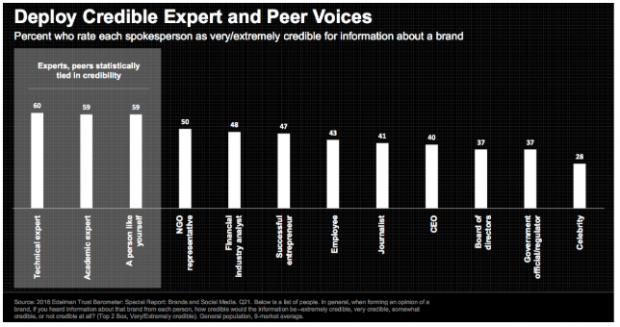
Smart brands are focusing less on maximizing reach and more on generating transparent, quality engagement. Companies like Adidas and The New York Times, for example, are working to develop intimate, meaningful dialogue with smaller, more valuable audience groups. They’re creating communities and sharing insightful and researched content—then getting out of the way and letting passionate users talk to one another. Hootsuite’s recommendations for this trendBeginner
To build conversation around your brand, create a short, easy-to-remember branded hashtag that brings your community together around a common interest. For example, Herschel Supply Co. has a popular branded hashtag, #welltravelled, for people who love to travel. They encourage their customers to share photos of Herschel products while exploring beautiful corners of the world. Use hashtags to align users around a brand value or noble purpose, rather than just a product offering.
A Twitter chat is a public discussion on Twitter around a specific hashtag. Twitter chats are a great way to build community by generating lively discussions around your customers’ interests. The chats are held at a specific time, cover one topic or theme, and are led by a moderator. Hootsuite hosts a monthly #Hootchat on social media marketing and strategy, bringing together a group of engaged participants who want to learn more about social media for business.
If you have a Facebook Business Page, you can easily create a Facebook Group to complement it. While your page will offer more general information, your Facebook Group can address niche interests and target your superfans. The key for brands is to create a space where customers can talk to one another. Facilitate that engagement and then get out of the way. Avoid heavy-handed pitches or product plugs. You can choose to make your group public or closed, and you should clearly identify the purpose of the group so people know why it exists. Advanced
When planning campaigns, consider hiring a micro-influencer to improve the quality of your outreach with more niche audiences. Unlike well-known or celebrity influencers, micro-influencers have smaller, highly engaged social media audiences. They are more affordable for brands, are viewed as more trustworthy by consumers, and often drive better results. One of the easiest ways to find micro-influencers is through a hashtag search on Twitter or Instagram. This will help you find people that have influence in your industry. To learn more about micro-influencers, check out this overview.
Public groups on Facebook are open to everyone. Closed groups can be found via search but need admin permission to join. And then there are secret groups: invisible and unsearchable to the outside world. The only way to join is to get a member to invite you. For the right brands, secret groups can be an effective way to create an aura of exclusivity or intrigue, especially in the context of launches and special promotions. And members, free from the prying eyes of the outside world, may feel freer to share ideas. Check out MEL Magazine’s profile of the potato-chip themed Gettin’ Chippy With It Facebook Group.
To keep customer trust, it’s important to communicate often, address problems proactively, and be as transparent as possible. Facebook Live Q&As are an excellent place to start. They make your brand feel more human by having someone talk to customers in real time. They’re also easy to manage and budget-friendly to run. Don’t worry about scripting beforehand—the goal is to be authentic and engaging in an informal setting.
To share technical info and unique insights, tap into the experts already on your team, from product specialists to your CEO. And encourage employees to reshare branded social content that’s relevant to their unique audiences. Dedicated social employee advocacy tools can streamline the process of creating and amplifying social content. Trend 2: Storifying socialContent teams adapt as Stories offer new formats for sharing
According to consulting firm Block Party, Stories—the vertical, disappearing videos invented by Snapchat—are now growing 15 times faster than feed-based sharing. Facebook’s own chief product officer Chris Cox shared a chart showing that Stories are set to surpass feeds as the primary way people share things with their friends within the next year. And nearly a billion users across WhatsApp, Instagram, Facebook, and Snapchat already turn to Stories to share. 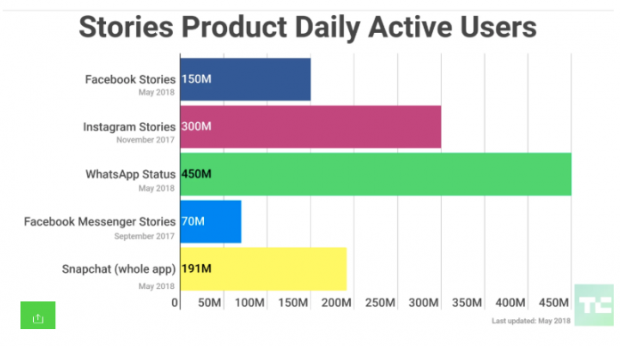
Social media is pivoting from text-based platforms originally designed for desktop use (think early Facebook) to truly mobile-only networks that enable users to capture in-the-moment experiences—and Stories embody that pivot. Stories are overwhelmingly visual and meant to be created and consumed on the fly with nothing more than a smartphone and a creative eye. Because they’re ephemeral—often disappearing after a day—there’s more room for fun and experimentation. Stories feel real, immediate, and intensely personal. For brands, this social media trend requires a major shift in focus in 2019. While high-production-value posts are still important, it’s key to balance different content styles. Increasingly, brands are embracing the intimate, multimedia look and feel of Stories. The Guardian and Tictail are finding that less polished, more realistic Stories perform better than heavily edited takes filled with heavy-handed calls to action. Hootsuite’s recommendations for this trendBeginner
An estimated four out of five major brands are already on Stories. If you aren’t creating Stories, it’s time to start. Stories can be as easy to create as you choose, so there’s a low barrier to entry for any team’s skill set. Share content weekly (and at different times of day) to see what works best with your audiences. Pro tip: Shoot your videos vertically. That’s how people watch them.
Your content should reflect the unique look and feel of Stories—raw, unedited, and live action. Our social team at Hootsuite tested both professionally animated and live action Instagram Stories, and found that live action videos performed significantly better because they matched the Story aesthetic people are used to seeing.
Despite their off-the-cuff style, Stories can sometimes take a lot of time to create and share. For brands reluctant to let their efforts simply disappear after 24 hours, there’s Highlights. Display select Stories as long as you want on your profile, along with a cover image. This feature is great for special promotions, campaigns, or longer, high-production videos that deserve extra attention.
Stories work best when they integrate video, storytelling, text, images, and more. Expecting a single social media specialist to integrate all these skills is a tall order. Instead, find ways for your video, photography, and graphic design teams to join forces to create something memorable. Advanced
Stories are easy to create and allow you to produce content quickly, so you should experiment with different structures to find what works best for your brand. For example, you can create tutorials showing people how to use your product, give a behind-the-scenes look at your company culture, host a takeover, or run a Q&A on topics that interest your customers.
Business accounts with over 10,000 followers (or verified accounts) can add a “swipe up†feature to their Stories. This lets viewers follow a link to another website or landing page. By adding UTMs to your Story URLs, you can track where users are going and get a better understanding of what content they like. If you don’t have access to the “swipe up†feature, add a link with a UTM code to your bio.
So far, Facebook Stories (which appear on the network’s flagship platform) haven’t really caught on. But CEO Mark Zuckerberg wants to get Stories right on Facebook and is investing a lot in the format. Currently, only around nine percent of major brands post to Facebook Stories, but companies that get in early may enjoy an early adopter advantage. Plus, it’s easy—the tap of a button lets you syndicate Stories straight from Instagram to Facebook.
Consider adding augmented reality features and GIFs to your storytelling. AR experiences and GIF stickers are now widely available as features of the Stories cameras on Facebook, Instagram, and Snapchat. Use GIFs to enhance your images, grab attention, and direct viewers’ attention to something like a call-to-action or “swipe-up.†Trend 3: Closing the ads gapMore competition on paid social forces marketers to up their game
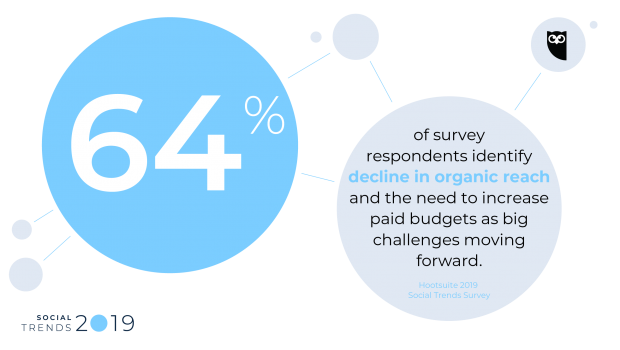
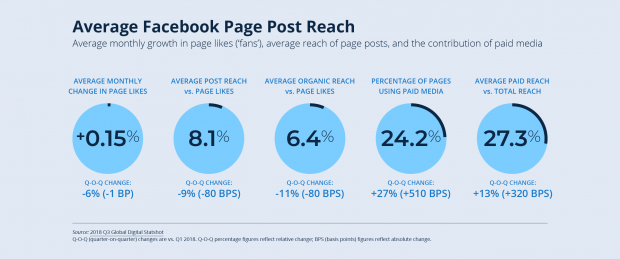
By now, everyone knows we’re in the pay-to-play era on social. Accordingly, marketers are increasing social ad budgets (up 32 percent in 2018 alone) and producing more ads than ever before. One of every four Facebook Pages now use paid media. And Facebook already accounts for 23 percent of total U.S. digital ad spending. But rising costs and fleeting attention are limiting ROI for advertisers. To counter this, paid social teams are pairing ad money with equal time investment, creativity, and targeting savvy. And they’re paying to boost their best performing organic content. Bonus: Get all the insight and tools you need to inform your social strategy in 2019 with our free social trends toolkit. Find out how successful brands are adapting to each trend, access data from over 3,000 customer surveys, and read the full report. Get the free toolkit now!Spotify and Netflix are leading the way with creative social ads that are at once personalized and entertaining, rather than just bland banner ads squeezed into a news feed. The end goal is to generate user discussion and engagement, rather than simply “broadcast†an ad at an audience. We’re seeing brands build out their social teams (both in-house and agency) with skilled cross-platform content creators versed in video, motion graphics, design, and more. Enhanced third-party ad targeting tools, which enable easy A/B testing (in some cases with hundreds of variants), are also becoming the norm. |
Amazing WeightLoss Categories
All
Archives
November 2020
|
 RSS Feed
