
RICK REA: Helping You Grow Through Online Marketing
  • Home
  • Blog
    • Social Media News
    • SEO Marketing News
    • Digital Trends News
    • Photography News
    • Mobile Marketing
    • Business News
    • Gadget News
    • Printing News
  • Contact
  • About
  • Subscribe

Printing News


TU Wien & Cubicure Develop Ivory Substitute for 3D Printing Restoration Pieces

4/30/2021

0 Comments

 
https://ift.tt/3xFmg7A

TU Wien & Cubicure Develop Ivory Substitute for 3D Printing Restoration Pieces

https://ift.tt/3xDdzdB

Ivory, a hard, white material consisting mainly of dentine, makes up the tusks of several large animals, such as walruses, narwhals, and elephants. For a long time, the material was highly sought after for use in making artwork, but thankfully the ivory trade was banned internationally in 1989 to protect decreasing elephant populations. However, a lot of this intricate artwork, as well as ivory artifacts, is obviously still out there, and alternate materials, such as bones, plastic, and shells, are used to restore them, with middling results. But a partnership between the Vienna University of Technology (TU Wien) and Cubicure GmbH, the university’s spinoff company, has resulted in a 3D printable, elephant-friendly substitute for ivory that can be used to restore these pieces with high precision.

Through a cooperation with the Archdiocese of Vienna‘s Department for the Care of Art and Monuments and Vienna-based Addison Restoration KG, Cubicure and TU Wien have created Digory, a novel material made of calcium phosphate particles, silicon oxide powder, and synthetic resin. First processed in a hot, liquid state, Digory is hardened into the desired shape using UV rays, and once it’s off the printer, it can be polished and color-matched to a specific artifact or piece of art.
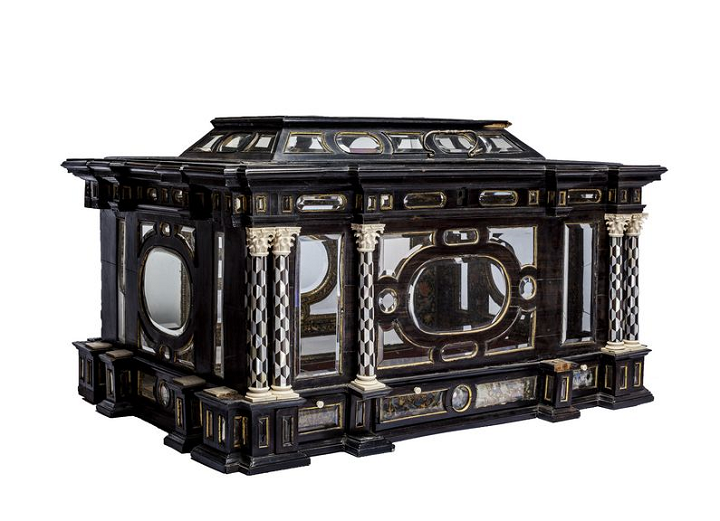
The state casket of Frederick the Fair (17th century)

“The research project began with a valuable 17th-century state casket in the parish church of Mauerbach. It is decorated with small ivory ornaments, some of which have been lost over time. The question was whether they could be replaced with 3D printing technology,” explained Professor Jürgen Stampfl from TU Wien’s Institute of Materials Science and Technology.

The research team published a paper on their work using stereolithography-based 3D printing to create the ivory-like material.
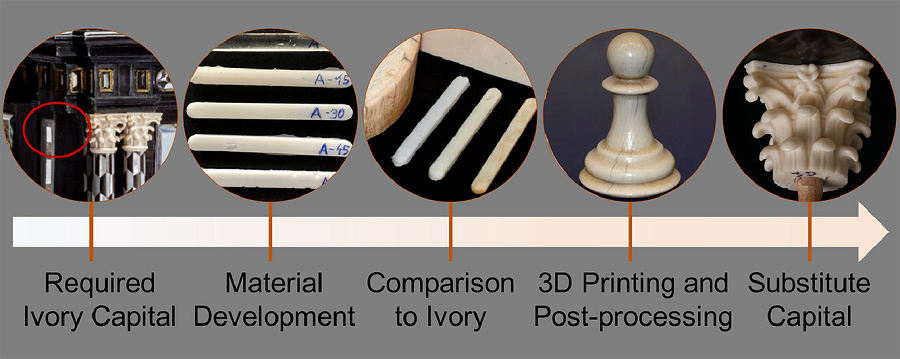
“To restore sometimes very complex and delicate artefacts, it is economically reasonable to develop a substitute that can be built by additive manufacturing to reduce carving time and material waste. Such a substitute material should especially mimic the aesthetic characteristics of ivory by means of the colour, translucency and surface gloss. All merchantable 3D printable substitute materials have evidential limitations in exactly those important characteristics. The newly developed substitute material called “Digory” is processible with an additive manufacturing technique that derived from stereolithography,” they explained in the abstract.

Graphical abstract

The team has previously worked with ceramics for dental technology, so they had some experience with similar materials, but an ivory substitute was a tall order.

“We had to fulfil a whole range of requirements at the same time. The material should not only look like ivory, the strength and stiffness must also be right, and the material should be machinable,” explained Thaddäa Rath, who worked on the project for her dissertation.

“You also have to bear in mind that ivory is translucent. Only if you use the right amount of calcium phosphate will the material have the same translucent properties as ivory.”

The team spent lots of time experimenting before finally coming up with the right mixture to create the Digory material.  They embedded tiny calcium phosphate particles, with an average 7 µm diameter, and very fine silicone oxide powder in a special resin, which is then processed at high temperatures in Cubicure’s hot lithography 3D printers.
“Layer by layer, a photosensitive slurry that consists mainly of a dimethacrylic resin filled with calcium phosphate particles is polymerized with a UV laser,” they explained in their paper. “The solids loading, which was adjusted to fit the translucency of ivory, was around 30 vol.%. At this content, the density of about 1.79 g cm−3 and the hardness of 35.7 HV0.2 are equivalent to the values for ivory found in the literature. Small quantities of yellow and red colour pigments were used to modify the basic colour. With further post-processing using traditional handcraft techniques, such as staining and polishing of the surface, an optical imitation of natural ivory was achieved.”

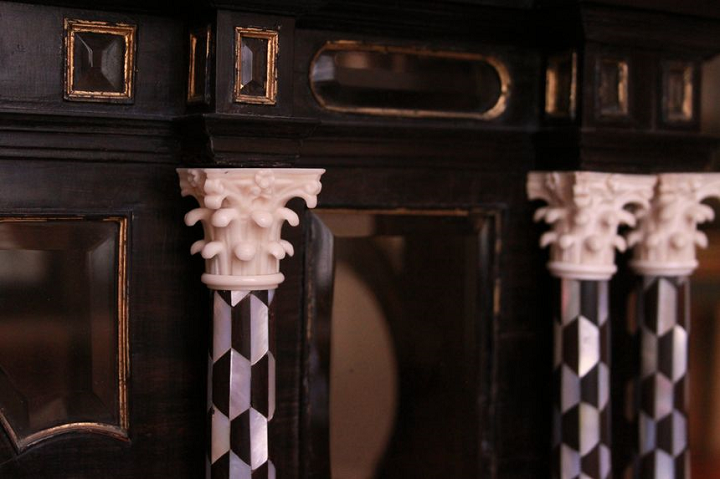
Closeup of casket ornaments

Once the item has been printed, it’s then polished and dyed to match the color of the artifact that is being restored, such as the ivory ornamentation on that 17th-century casket. The researchers reported good results using black tea for the touch-up work, and noted that you can also add the dark lines often seen running through ivory to the piece afterwards.

This is big news for the restoration field, as the team says that Digory is easier to work with than other substitutes, and replicates the stiffness, strength, and translucence of real ivory. Additionally, no elephants had to lose their tusks to restore an artifact, and 3D printing makes it possible to automatically, and quickly, reproduce the fine details of these pieces.
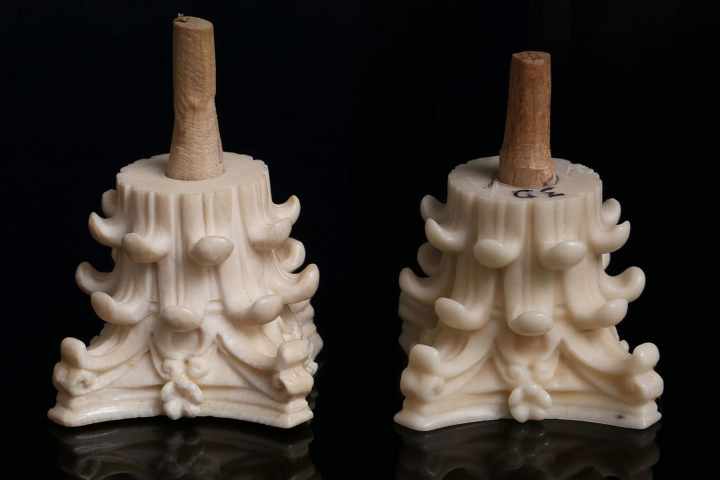
L-R: Ivory, new Digory material

Cubicure’s Konstanze Seidler said, “With our specially developed 3D printing systems, we process different material formulations for completely different areas of application, but this project was also something new for us. In any case, it is further proof of how diverse the possible applications of stereolithography are.”

The researchers hope once the novel Digory material is further developed, it will become more accepted as “an aesthetically and mechanically high-quality” substitute for ivory, and can be used as a restoration material, as well as putting illegal poachers out of business.

(Source: New Atlas / Images: TU Wien)


Printing

via 3DPrint.com | The Voice of 3D Printing / Additive Manufacturing https://3dprint.com

April 30, 2021 at 09:06AM


0 Comments


Leave a Reply.

    Categories

    All
    3-D Printed Ultrasound Models
    3-D Printing
    3D Printing
    Tools For The Visually Impared
    Visually Impared

    Archives

    May 2023
    April 2023
    March 2023
    February 2023
    January 2023
    December 2022
    November 2022
    October 2022
    September 2022
    August 2022
    July 2022
    June 2022
    May 2022
    April 2022
    March 2022
    February 2022
    January 2022
    December 2021
    November 2021
    October 2021
    September 2021
    August 2021
    July 2021
    June 2021
    May 2021
    April 2021
    March 2021
    February 2021
    January 2021
    December 2020
    November 2020
    October 2020
    September 2020
    September 2019
    August 2019
    July 2019
    June 2019
    May 2019
    April 2019
    March 2019
    February 2019
    January 2019
    December 2018
    November 2018
    October 2018
    September 2018
    August 2018
    July 2018
    June 2018
    May 2018
    April 2018
    March 2018
    February 2018
    January 2018
    December 2017
    November 2017
    October 2017
    September 2017
    August 2017
    July 2017
    June 2017
    May 2017
    April 2017
    March 2017
    February 2017

    RSS Feed

Powered by Create your own unique website with customizable templates.
  • Home
  • Blog
    • Social Media News
    • SEO Marketing News
    • Digital Trends News
    • Photography News
    • Mobile Marketing
    • Business News
    • Gadget News
    • Printing News
  • Contact
  • About
  • Subscribe
